
How to Wrap a Silk Pillowcase as an Elegant Gift
Lunelle Team
11 min read
You have found a genuinely good gift. A silk pillowcase: thoughtful, useful, and the kind of thing the recipient will quietly use every single night and never buy for themselves. The problem is that it is currently sitting on your kitchen table in the shopping bag it came in, and it looks like an afterthought rather than a considered gesture. Our broader guide to presenting a silk gift elegantly covers every stage from choosing the right pillowcase to the final card; this article focuses specifically on the wrapping method and what not to do with the fabric itself.

Gift presentation is not a superficial concern. Research on Japanese gifting culture from the Japan National Tourism Organization suggests that the presentation of a gift often signals more about the giver's care and thoughtfulness than the object itself. When the gift is silk, the wrapping does two jobs simultaneously: it communicates the quality of what is inside, and it protects a fabric that is more delicate than most people assume.
This guide covers everything: why a silk pillowcase is a genuinely useful gift (stated honestly, without the usual beauty-brand hyperbole), exactly what to look for when buying one, and the presentation method that does justice to what is inside. There is also a section on what not to do, because some very common gift-wrapping instincts turn out to be quietly terrible for silk fabric, and it seems unfair not to mention that.
Quick Answer
To wrap a silk pillowcase elegantly: fold it loosely and place it in a rigid gift box with unbuffered acid-free tissue paper inside. Avoid crumpling or sharp folds. For the outer presentation, use a reusable cloth wrap in the furoshiki style, secured with a ribbon or fabric tie. Include a small care card with washing instructions. Skip airtight bags, alkaline buffered tissue, and anything that creates deep, permanent creases in the fabric.
Key Takeaways
- The wrapping matters: gift presentation signals care, and for a silk item, the right box and tissue also protect the fabric.
- Use unbuffered acid-free tissue inside the box. Standard alkaline-buffered tissue can damage silk fibres over time.
- Furoshiki-style wrapping is the most elegant outer presentation: reusable, sustainable, and far more impressive than metallic paper.
- A care card makes the gift feel more complete and genuinely useful to the recipient.
- Avoid airtight plastic bags, sharp folds, and direct sunlight. All of which can damage silk before the gift is even opened.
In This Article
- Why a Silk Pillowcase Makes a Genuinely Thoughtful Gift
- Silk vs Satin: Why It Matters When You Are Giving a Gift
- What Makes a Silk Pillowcase Worth Giving
- The Elegant Presentation Formula
- How to Do Furoshiki-Style Wrapping
- What Not to Do When Wrapping Silk
- Occasions When a Silk Pillowcase Is the Perfect Gift
- The Care Card: a Small Detail That Makes a Big Difference
- Frequently Asked Questions

Eleven minutes of reading so the next two minutes of unwrapping go right. 🎁 🥂
Shop →Why a Silk Pillowcase Makes a Genuinely Thoughtful Gift
Not every gift that sounds luxurious is actually useful. A silk pillowcase is both. It is something people sleep on every night, it has real material benefits that are well-supported by dermatology research, and it is the kind of upgrade most people would not purchase for themselves without a nudge.
The key benefits are rooted in friction, not magic. Dermatologists at the American Academy of Dermatology note that friction from a pillowcase can make curly and tightly coiled hair frizzier and easier to break, and they specifically recommend silk or satin pillowcases to reduce mechanical stress overnight. For anyone who spends time on their hair, or who struggles with overnight frizz, tangles, or fragile strands, this is a practical benefit rather than a marketing claim.
On the skin side, peer-reviewed research published in PubMed has linked sleeping position and the compression of the face against a pillow surface to the formation of sleep lines and wrinkles over time. The American Academy of Dermatology also notes that side or stomach sleeping may contribute to facial and chest sleep creases. A smoother, lower-friction surface may mean fewer of these temporary impressions, though it is worth being clear: a silk pillowcase is not a substitute for SPF or a dermatologist's retinoid prescription. It is a thoughtful upgrade to a surface you already use every night.
There is also a comfort argument that stands on its own. Britannica notes that silk is naturally moisture-absorbent, and Good Housekeeping's laboratory testing found that high-quality silk pillowcases score well for moisture management and temperature regulation. People who describe sleeping on silk as "cool and comfortable" are not imagining things.
For anyone with sensitive or reactive skin, Eczema UK describes silk as soft, breathable, and a good regulator of body temperature. This makes it a considered choice for a recipient with sensitive skin, though it is worth noting that silk does require more careful laundering than cotton. A care card is not optional for this recipient: it is essential.
Our article on why hair gets staticky overnight goes deeper on the friction question, including the physics behind overnight charge build-up and what different hair types can realistically expect from a switch to silk.

Silk vs Satin: Why It Matters When You Are Giving a Gift
This distinction is more important than most gifting guides acknowledge, and it is one that catches people out in shops and on product pages regularly.
Silk is a natural fibre. It is produced by silkworms and has a specific protein structure (fibroin) that gives it its well-known properties: smoothness, breathability, moisture management, and temperature regulation. Satin, on the other hand, is a weave. It describes how threads are interlocked in a fabric, not what those threads are made of. A satin weave can be applied to silk, polyester, nylon, or any other fibre.
A "satin pillowcase" from a supermarket is almost certainly polyester in a satin weave. A silk pillowcase labelled "100% mulberry silk" is the real thing. They may feel similar in the shop. They will not feel similar in six months, and they will not behave remotely the same in a wash.
Good Housekeeping's textiles team explains this clearly: when readers see "silky-smooth" in a product description and take it to mean genuine silk, they are often buying a polyester fabric in a satin weave. It may feel smooth in the shop. It will behave very differently over time and may not offer the same breathability or friction-reducing properties that real silk does.
When buying a silk pillowcase as a gift, look for the words "100% silk" or "100% mulberry silk" and a stated momme weight. If neither appears on the product page, it is worth asking or shopping elsewhere. Our article on whether mulberry silk is genuinely different from other silk types goes into the evidence behind why the fibre grade matters, and what the research actually supports versus what is marketing.
What Makes a Silk Pillowcase Worth Giving
The difference between a silk pillowcase that earns its reputation and one that disappoints inside six months comes down to a handful of specific, checkable criteria. When a gift is intended to communicate quality, the product needs to actually be of quality.
| What to Check | What to Look For | Why It Matters |
|---|---|---|
| Fibre content | 100% mulberry silk | Mulberry silk has longer, more uniform fibres, making it smoother and more durable than lower-grade alternatives |
| Momme weight | 22 momme minimum; 30 momme for a premium feel | Higher momme = thicker, stronger, more abrasion-resistant fabric |
| Certification | OEKO-TEX Standard 100 | Independently tested for harmful substances, reassuring for a gift going near someone's face |
| Closure | Envelope or zip closure | Keeps the pillow inside securely during sleep; a zip closure is particularly secure |
| Care instructions | Machine washable on delicate cycle | Ease of care determines whether the gift stays in use long-term |
| Packaging | Gift-ready box or presentation case | Protects the fabric and elevates the unboxing experience |
Good Housekeeping's testing found that mulberry silk has longer and more uniform fibres than lower-grade silk varieties, which directly translates to a smoother surface and better durability. For a gift that is supposed to represent a genuine upgrade, this is the material specification that earns the word "luxury."
A silk pillowcase at 22 momme from Grade 6A mulberry silk is not the same product as a polyester satin from a gift shop. The differences become clear in month three, not in the shop.
The Elegant Presentation Formula
The method that both protects the silk and presents it beautifully follows a simple four-part structure. It draws on textile conservation guidance rather than generic wrapping advice, because the conservation community has spent considerably more time thinking about how to handle delicate fabrics than the average gift wrap tutorial has.
Step 1: The Right Box
A rigid box is essential. A silk pillowcase tightly cinched inside a soft gift bag will arrive looking like it spent time under a seat. Rigid boxes protect the shape of the fold and allow the tissue inside to do its job without compressing the fabric.
If a giftable box is not included with the product, a flat, rigid card box slightly larger than the folded pillowcase is the right choice. The pillowcase should fit with room to spare rather than being squeezed into corners.
Step 2: The Right Tissue
This is where most people make a well-intentioned but quietly damaging choice. Standard tissue paper sold in gift shops is often alkaline-buffered, which means it has been treated to be slightly alkaline to protect books and paper items from acidic degradation. For silk, this is counterproductive.
Unbuffered acid-free tissue looks identical to standard tissue paper. The packaging will specify "acid-free" and "unbuffered" or "neutral pH." If it does not say both, use the tissue for something else.
Step 3: The Fold
The Smithsonian's textile storage guidance warns that sharp folds can cause splits in fragile textiles. For a gift presentation, fold the pillowcase loosely in half and then loosely again, rather than in tight, crisp thirds. The goal is to minimise the number of folds and to keep them as gentle as possible. Lay the folded pillowcase on a layer of tissue and wrap the tissue loosely around it before placing it in the box. This creates a soft cushion and protects the surface from the box itself.
Step 4: The Outer Presentation
Once the box is prepared, the outer wrapping is where the gift becomes genuinely memorable.

How to Do Furoshiki-Style Wrapping
Furoshiki is a Japanese textile wrapping tradition that Japan House describes as a single square cloth capable of wrapping many different shapes and being reused repeatedly. The Japan National Tourism Organization notes that in Japanese gifting culture, the presentation of a gift is often considered as meaningful as the gift itself, and furoshiki is the physical expression of that philosophy.
For a boxed silk pillowcase, furoshiki-style wrapping is ideal: it looks far more considered than metallic paper, it is completely reusable, and it suits the sustainability positioning of a product marketed as a long-term bedding investment.
What You Need
- A square of fabric approximately 70 to 90 cm across (a large cotton or linen square works well; a patterned silk scarf is the more indulgent option)
- The prepared rigid box
- A ribbon, cord, or fabric tie in a complementary colour
Basic Furoshiki Box Wrap
- Lay the fabric square on a flat surface, pattern side down if it has one.
- Place the box in the centre of the fabric, rotated 45 degrees so the corners of the box point toward the sides of the cloth rather than the corners.
- Lift the two nearest corners of the fabric up over the box and cross them over the top, pulling them snug against the sides of the box.
- Take the remaining two corners and bring them up and over the crossed fabric. Tie these two corners together in a simple knot or bow on top of the box.
- Adjust the fabric so it lies flat and even, and the knot sits centred on top.
The result is a wrapped box with no visible tape, no paper waste, and a fabric outer wrap the recipient can use again. The cloth itself becomes part of the gift.
Disposable metallic paper and a curling-ribbon bow is a perfectly competent wrapping choice. It is also what everyone does. Furoshiki is what people remember.
What Not to Do When Wrapping Silk
Some of the most common gift-wrapping instincts are genuinely problematic for a silk item. The Smithsonian and Victoria and Albert Museum's textile conservation guidance is instructive here, even if neither institution has a dedicated silk pillowcase gifting guide.
What to Avoid When Wrapping Silk Gifts
- Airtight plastic bags or vacuum-seal packaging. Moisture condensation inside plastic can damage silk fibres, and the bag will look completely innocent about it.
- Alkaline-buffered tissue paper. It degrades silk protein structure over time. Use unbuffered acid-free tissue only.
- Sharp, crisp folds. These can cause permanent crease lines or stress splits in the fabric.
- Direct sunlight during storage or display. UV light fades silk dye and weakens the fibre simultaneously.
- Tightly cinched ribbon directly around the pillowcase. This creates pressure points and potential crease marks on the fabric.
- Damp or humid storage. Silk is moisture-absorbent and prolonged humidity can encourage mould. Our guide to how to store silk properly covers the full conditions in detail.
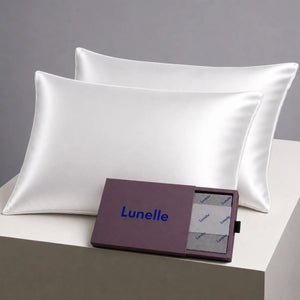
Lunelle 22 Momme Silk Pillowcase
Set of 2 · 100% Grade 6A Mulberry Silk · OEKO-TEX Certified
A silk pillowcase gift is only as good as the silk it is made from. The Lunelle 22 momme pillowcase is made from Grade 6A mulberry silk in a charmeuse weave: the combination that gives silk its characteristic smoothness and that specifically addresses the friction problem dermatologists reference when recommending silk pillowcases for hair and skin. At 22 momme, it sits within Good Housekeeping's recommended range for quality and durability.
- 100% Grade 6A mulberry silk
- 22 momme for the ideal balance of softness and durability
- Charmeuse weave for a smooth, low-friction surface
- OEKO-TEX certified, free from harmful chemicals
- Envelope closure
- Machine washable on a delicate cycle
- 60-night guarantee
Occasions When a Silk Pillowcase Is the Perfect Gift
A silk pillowcase is a versatile gift precisely because it is personal and practical without being intrusive. It improves something the recipient already does every night, without requiring them to change their routine.
Birthday
The gift that says you actually listened. Particularly well-suited to a milestone birthday, or for someone who has mentioned overnight frizz, skin sensitivity, or the general indignity of bad sleep. It communicates genuine thought without making the occasion weird.
New Home
A new bed in a new space deserves something better than a scented candle. A silk pillowcase is the housewarming gift that makes people feel like they have actually moved in, rather than just relocated their furniture and changed their address.
Post-Surgery or Recovery
For someone recovering from cosmetic surgery, a health procedure, or who has been advised to sleep on a low-friction surface, a silk pillowcase is genuinely useful rather than merely indulgent.
Mother's Day or Father's Day
A gift that works quietly every night and lasts for years without requiring anything from anybody. The parents who insist they want nothing always mean they do not want something forgettable. This clears that bar without any effort.
Wedding or Anniversary
A set of two is practical for a couple and signals that the giver thought about both people rather than defaulting to the one they know better. A surprisingly rare distinction in gift-giving, and one that tends to be appreciated. The presentation particularly suits this occasion.
Christmas
The kind of thing people would not justify at full price for themselves but will use gratefully every night for years. Which is, if you think about it, exactly what a gift is supposed to be. It also photographs beautifully under a Christmas tree, which has never hurt anyone.

The Care Card: a Small Detail That Makes a Big Difference
A care card takes two minutes to prepare and meaningfully increases the value of the gift. Cleveland Clinic recommends washing sheets at least once a week, but silk requires a gentler approach than most people's standard laundry routine. A recipient who does not know how to care for silk properly may damage it in the first wash, which is a regrettable outcome for an otherwise excellent gift.
The care card transforms the gift from a single object into something the recipient can confidently keep. It also signals that the giver has done the research, which adds to the impression of thoughtfulness.
Most beautiful gifts last thirty seconds in the hands of the recipient before they disappear into a drawer. A care card is what happens when you plan for the next three years instead.
What to Include on a Silk Pillowcase Care Card
- Washing: Machine wash on a delicate or silk cycle at 30°C or below. Use a pH-neutral, enzyme-free detergent. A mesh laundry bag is recommended.
- Drying: Do not tumble dry. Lay flat or hang to dry in shade, away from direct sunlight.
- Ironing: Iron on the silk setting (low heat), on the reverse side, with a pressing cloth if possible.
- Frequency: Wash every one to two weeks for regular use.
- Storage: Store away from direct light in a breathable cotton bag or drawer. Avoid plastic.
For more detail, our guide to caring for printed silk garments covers the additional steps that protect patterned pieces.
22 Momme or 30 Momme: either way, it is the gift that gets used every night.
Both are 100% Grade 6A mulberry silk, OEKO-TEX certified, and machine washable. The 22 momme is the right starting point; the 30 momme is for someone who already knows.
Available in: 22 Momme and 30 Momme, Set of 2 →
Grade 6A mulberry silk. OEKO-TEX certified. 60-night guarantee.
Frequently Asked Questions

Is a silk pillowcase a good gift idea?
Yes, for almost any recipient who sleeps on a pillow, which is most people. A silk pillowcase is used every single night, has real benefits backed by dermatology research, and is the kind of thing people would not buy for themselves but are quietly delighted to receive. Present it well and it punches considerably above its price point. The main exception is someone who has recently declared that silk pillowcases are a waste of money, in which case, perhaps a candle.
What is the difference between silk and satin pillowcases?
Silk is a natural fibre; satin is a weave. A satin pillowcase can be made from silk, but more often it is made from polyester in a satin weave. The two may look similar on a shelf but behave very differently in use: real silk is breathable, moisture-managing, and made from a protein fibre; polyester satin is synthetic and does not share these properties. Always check the fibre content when buying. "100% mulberry silk" means genuine silk. "Satin" alone does not.
What momme weight should I choose for a silk pillowcase gift?
Good Housekeeping recommends a minimum of 19 momme for a genuine silk pillowcase and 22 momme or higher for the best quality. For a gift, 22 momme is the sensible starting point: it offers the right balance of softness and durability for daily use. If you want to give something more premium, 30 momme provides a noticeably thicker, more substantial feel. Both are meaningful steps up from a lower-momme option.
Can silk pillowcases really help with hair frizz and breakage?
The mechanism is well-supported, though the results vary by hair type. The American Academy of Dermatology notes that friction from a pillowcase can make curly and coily hair frizzier and more prone to breakage, and recommends silk or satin pillowcases to reduce that friction. The benefit is most noticeable for hair types already prone to overnight frizz, tangles, or mechanical damage. It is not a cure for hair damage, but it addresses a real and consistent contributing factor.
Do silk pillowcases help with wrinkles?
Honestly: possibly, but modestly. Peer-reviewed research has linked sleeping position and facial compression to the formation of sleep lines over time. A smoother surface may mean fewer of those impressions. What a silk pillowcase cannot do is prevent deep wrinkles, replace SPF, or substitute for a retinoid prescription. Anyone who tells you otherwise is selling something. It is a genuinely useful upgrade to a surface you already use every night. It is not a skincare treatment.
What tissue paper should I use inside a silk gift box?
Unbuffered acid-free tissue paper. Standard gift shop tissue paper is often alkaline-buffered, which the Smithsonian Museum Conservation Institute notes can be harmful to silk and wool. Acid-free, unbuffered tissue is available from specialist stationery suppliers and some art supply shops. It looks identical to regular tissue paper, the packaging will specify "acid-free" and "unbuffered" or "neutral pH."
What is furoshiki wrapping and how do I do it?
Furoshiki is a Japanese textile wrapping tradition using a square of cloth rather than paper. Japan House describes it as a single square cloth capable of wrapping many different shapes and being reused repeatedly. For a boxed silk pillowcase, place the box in the centre of a square cloth (approximately 70 to 90 cm across), rotate it 45 degrees, fold the nearest two corners over the box, and tie the remaining two corners in a knot or bow on top. The cloth becomes part of the gift and can be used again by the recipient.
Should I include a care card with a silk pillowcase gift?
Yes, and it is not optional if the recipient has never owned silk before. Silk requires more careful laundering than cotton, and a recipient who defaults to their usual laundry routine may undo a significant gift in the very first wash. A small card with the key instructions (cool water, delicate cycle, pH-neutral detergent, no tumble dryer, dry in shade) takes two minutes to prepare and meaningfully extends the life of the gift. It also suggests, accurately, that the giver thought about more than just the presentation.
How often should a silk pillowcase be washed?
Every one to two weeks for regular use, using a delicate or silk cycle at 30°C or below with a pH-neutral, enzyme-free detergent. Cleveland Clinic recommends washing sheets at least weekly, and while silk is more delicate than cotton it still needs regular laundering, particularly for someone with skin concerns. Overwashing does cause cumulative wear, so the balance is regular but not excessive.
What should I avoid when storing a silk pillowcase as a gift?
Avoid airtight plastic bags (moisture condensation can damage silk fibres), alkaline-buffered tissue paper (degrades the protein structure), sharp folds (can cause permanent crease lines), and direct sunlight (fades the dye and weakens the fibre). Store the boxed gift in a cool, dry place away from light until it is given.
Can I give a silk pillowcase to someone with sensitive or reactive skin?
Yes, and it is often a particularly considerate choice. Eczema UK describes silk as soft, breathable, and a good temperature regulator, noting it may suit people with sensitive or reactive skin. However, silk requires more careful laundering than cotton, and skincare products can mark the fabric over time. If the recipient has a complex skincare routine, a care card that includes washing instructions is not just a thoughtful addition: it is a practical necessity.
Further Reading
Sources and References
- American Academy of Dermatology. 6 Curly Hair Care Tips from Dermatologists. aad.org
- Japan National Tourism Organization. Japan's Gifting Culture and Gift Ideas with MUJI. japan.travel
- PubMed. The Influence of Sleeping Position on the Formation of Facial Wrinkles. pubmed.ncbi.nlm.nih.gov
- Britannica. Sericulture: Silk Production and Benefits of Silk Farming. britannica.com
- Eczema UK. Clothing and Eczema: Fabric Guide. eczema.org
- Smithsonian Museum Conservation Institute. Acid-Free Tissue Paper for Textiles and Costume Storage and Handling. mci.si.edu
- Smithsonian Institution. How Do I Store Antique Textiles at Home? si.edu
- Japan House. Wrapping: Stories. japanhouse.jp
- Cleveland Clinic. How Often Should You Wash Your Sheets? clevelandclinic.org
- Good Housekeeping. 10 Silk Pillowcase Benefits for Skin and Hair, According to Dermatologists. goodhousekeeping.com
- Good Housekeeping. Best Silk Sheets of 2023, Tested by Experts. goodhousekeeping.com
- Good Housekeeping. Fishers Finery Silk Pillowcase Review: Tested by Experts. goodhousekeeping.com