
Can You Tumble Dry Silk? The Honest Answer Before You Ruin It
You have just washed your silk pillowcase, you are tired, and the dryer is right there, glowing with false promise. Before you press start, here is the answer you came for: in almost every case you should not tumble dry silk. The combination of heat and tumbling is the single fastest way to shrink it, dull its shine, roughen its surface, and shorten its life. A few silk items survive a no-heat air cycle, but the true silk-safe method is gentle air drying.
This guide explains exactly what happens inside the dryer, the rare exceptions, a harm-reduction plan for the moment you cannot avoid it, and the air-drying routine that keeps your silk smooth for years.
Quick Answer
Can you tumble dry silk? Almost never. Dryer heat and tumbling damage silk's protein fibres, causing shrinkage, dullness, roughness and weakening. Only tumble dry if the care label explicitly allows it, and then only on a cool or no-heat air cycle inside a mesh bag. For nearly all silk, air drying flat and away from direct heat is the correct method.
Key Takeaways
- Silk is a protein fibre (fibroin) that is vulnerable to heat, so standard warm or hot dryer cycles can shrink, dull and weaken it.
- Most silk is not dryer safe. Only tumble dry if the care label specifically permits it, and even then only on no-heat air-fluff.
- Tumbling causes fibre-to-fibre abrasion that gradually roughens silk's surface, undoing the smoothness you bought it for.
- Air drying flat on a clean towel, out of direct sun and away from radiators, is the safest way to dry a silk pillowcase.
- If you already tumble dried silk, some stiffness and dullness can be partly recovered, but shrinkage and fibre damage are usually permanent.
In This Article
- Can you tumble dry silk safely?
- What actually happens to silk in the dryer
- Is any silk dryer safe? The label rule
- Dryer settings compared: what each one does to silk
- If you absolutely must use a dryer
- How to air dry a silk pillowcase properly
- Silk that survives real-life laundry
- What to do if you already tumble dried silk
- Silk vs satin vs cotton: dryer tolerance
- Does momme weight change dryer risk?
- Decision checklist before you dry silk
- Frequently asked questions
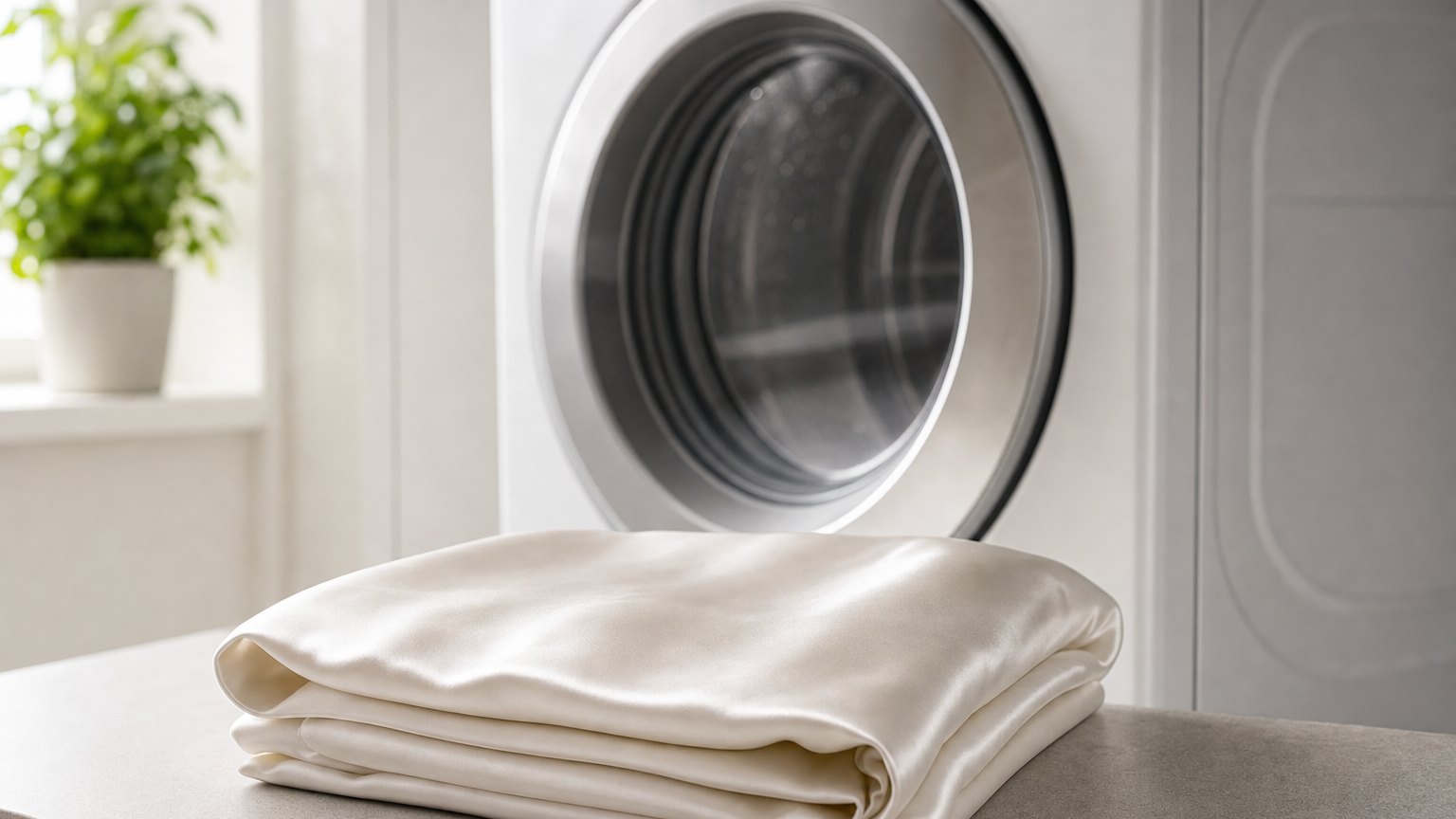
Can you tumble dry silk safely?
You can’t safely tumble dry most silk. Well, you can...in the same way you can wash your phone in the sink. It’s just unlikely to improve things. Some things are best left as a thought. Silk is a delicate natural protein fibre, and dryers specialise in its two least favourite activities: heat and being thrown repeatedly against a metal drum. So if you’re looking for a quick way to turn beautiful silk into something smaller, rougher and considerably less luxurious, the tumble dryer is remarkably efficient.
Even Cleveland Clinic dermatologists recommend silk and satin because they’re smoother and gentler than cotton. So roughening up that lovely smooth surface in the dryer is a bit like buying an expensive non-stick pan and then attacking it with steel wool. You’re basically undoing the thing you paid extra for in the first place, as Cleveland Clinic explains in its guidance on silk and satin pillowcases.
Expert Insight: Silk is a natural protein fibre and needs careful handling, which is why care guidance repeatedly steers it away from high heat and aggressive mechanical action rather than towards the dryer.
Source: Cleveland Clinic, dermatology guidance
What actually happens to silk in the dryer
Is any silk dryer safe? The label rule
Some silk can technically go in the dryer; However, before you celebrate and start tossing pillowcases in with the towels, there’s a catch. The care label needs to explicitly say tumble drying is safe. And even then, it usually means a cool or no-heat air cycle, not your dryer’s overly enthusiastic interpretation of “warm.” When in doubt, the care label wins. Every time.
Those little labels aren’t sewn in just to irritate you with microscopic writing and mysterious symbols. They’re there to tell you at least one safe way to clean and dry the item. So if yours says do not tumble dry, the manufacturer isn’t being dramatic or overly protective. They’re essentially saying, “Please don’t cook the silk we worked so hard to make.” Look for a square with a circle inside it and a cross through the whole thing, that’s the universal “keep me out of the dryer” sign.
And if you’re now wondering what other forms of domestic abuse your silk would prefer to avoid, our sister guide on how to wash silk properly covers the washing side of the equation, without requiring a minor panic attack.
Expert Insight: Good Housekeeping's laundry experts advise keeping delicate natural fibres like silk out of hot dryers and drying them flat or on low, no-heat settings only where a label allows, to preserve shape and finish.
Source: Good Housekeeping, laundry care
Dryer settings compared: what each one does to silk
The setting matters enormously, because the harm scales with heat and tumbling intensity. Here is how the common dryer options treat silk, from most damaging to least.
| Dryer setting | Heat level | Effect on silk | Verdict |
|---|---|---|---|
| High heat / cottons | Very high | Rapid shrinkage, dulling, brittleness, roughened surface | Never |
| Medium / permanent press | Moderate | Cumulative heat damage and loss of sheen over time | Never |
| Low heat / delicate | Low but present | Slower but still real fibre stress and abrasion | Avoid |
| Air fluff / no heat (label permits) | None | Tumbling abrasion only; least bad option if unavoidable | Last resort |
| Air dry flat (no dryer) | None | No heat, no abrasion, preserves sheen and shape | Best |
The pattern is clear: every heated setting is off the table, and even the no-heat air cycle still tumbles the fabric. Air drying wins because it removes both damaging forces at once.
Expert Insight: Appliance manufacturers class silk among delicate fabrics and route it to low-agitation, low-heat handling rather than standard drying, because standard cycles apply mechanical stress delicate fibres are not built to absorb.
Source: Maytag, fabric care guidance
The friction problem your dryer makes worse
The problem: Silk earns its spot on your bed by being ridiculously smooth. Unfortunately, the dryer seems to take that personally. Heat and tumbling gradually roughen the surface, so the pillowcase you bought to be gentle on your hair and skin can slowly become less… well, silky. A slightly expensive way to defeat the entire purpose.
The solution: Choose a well-made silk pillowcase that doesn’t require a degree in textile conservation to look after. One that can handle a gentle machine wash and is perfectly happy air-drying on its own. No elaborate rituals, no nervous hovering, and definitely no need to negotiate with the tumble dryer.

If you absolutely must use a dryer
If skipping the dryer genuinely isn’t an option, and the care label hasn’t specifically told you not to, there is a slightly less terrifying way to do it. The aim is to keep heat, friction and general dryer-related violence to an absolute minimum.
This is damage limitation, though. Not best practice. A bit like eating a salad alongside your chips.
Use no heat. And we really do mean no heat.
Choose an air-fluff or completely cool cycle. Not low heat. Not medium heat. Certainly not high heat. Silk and hot dryers have roughly the same relationship as commuters and unexpected eye contact on public transport. Best avoided.
Pop it in a mesh laundry bag.
A zipped mesh bag gives your silk a little protection from the drum and everything else bouncing around in there. It won't make tumble drying completely safe, but it does reduce the rubbing and abrasion. Think of it as a tiny suit of armour, only considerably more breathable.
Keep the cycle short.
This is not the time to press a button and wander off to make a cup of tea, or Joe..for our American cousins. Use the shortest cycle possible and take the silk out while it's still slightly damp. Then lay it flat and let the air finish the job. The dryer gets a brief guest appearance. Nothing more.
Skip the dryer sheets and fabric softener.
Silk is already soft. It doesn't need assistance. Dryer sheets and softeners can leave residue on the fibres, which may dull that lovely smooth finish you presumably paid good money for.
Think of the no-heat cycle as a stay of execution, not a pardon. Even without heat, your silk is still being repeatedly tossed around inside a metal drum, which isn't exactly a spa treatment.
So once it's nearly dry, get it out. Put the kettle on. Crisis averted.
Expert Insight: Byrdie's beauty and grooming editors advise against tumble drying silk and recommend laying it flat or hanging it to air dry, noting that heat is one of the quickest ways to degrade the fabric's finish.
Source: Byrdie, silk care
How to air dry a silk pillowcase properly
Air drying is the proper way to dry a silk pillowcase, and thankfully, it’s nowhere near as much faff as it sounds. Silk doesn’t hold masses of water, so you’re not going to be staring at a damp pillowcase for three working days.
The idea is simple. Get rid of the excess water gently, then let good old-fashioned air do the rest. No heat, no blazing sunshine and absolutely no wringing it out like a dishcloth.
-
Whatever you do, don’t wring it.
Twisting wet silk puts unnecessary strain on the fibres and can stretch the weave out of shape. Instead, gently press out the water. Your pillowcase has done nothing to deserve being throttled over the sink. -
Give it the towel treatment.
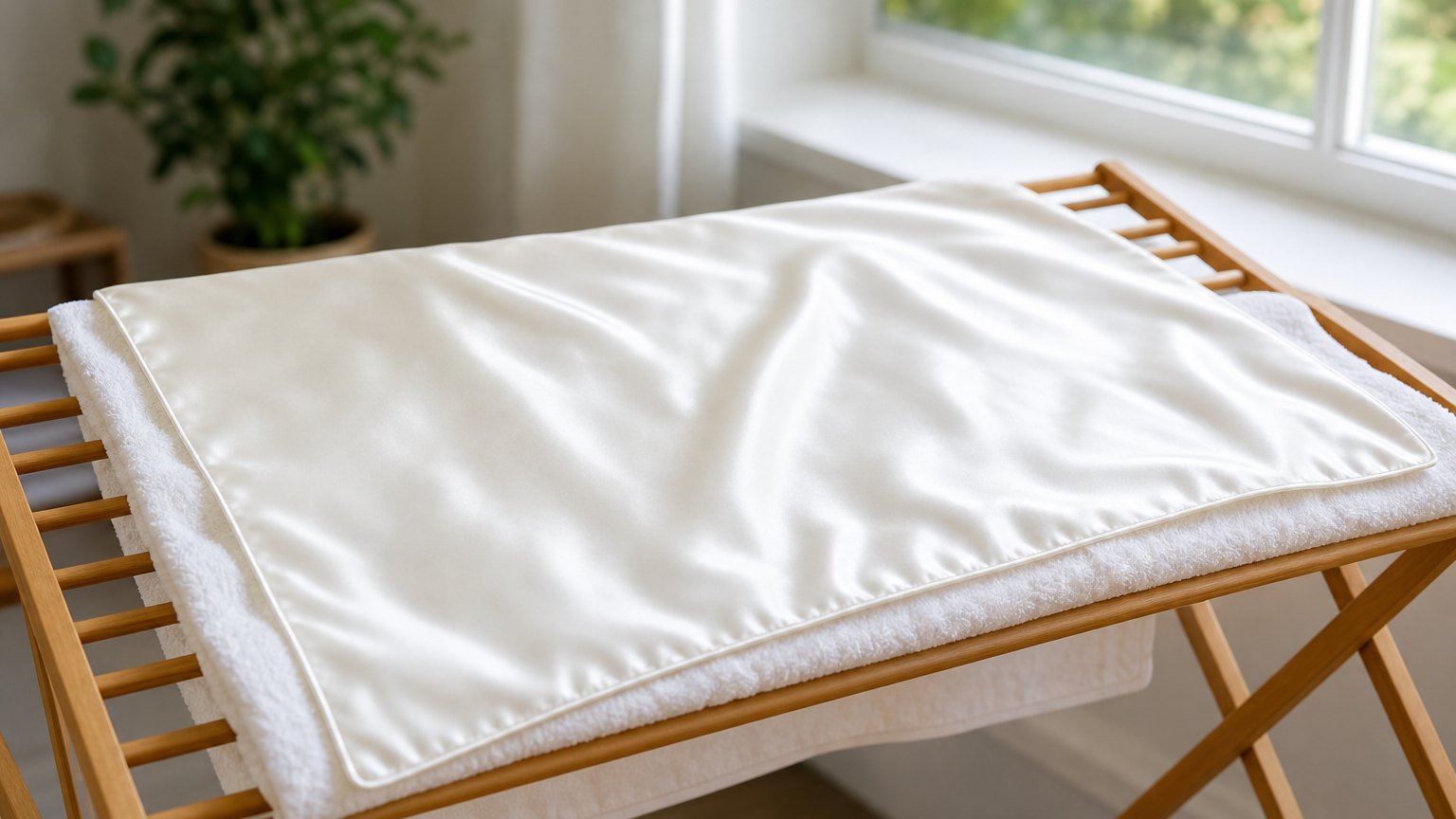
Lay the wet pillowcase flat on a clean, dry towel. Roll the towel and silk together, then gently press to blot out the excess moisture. No aggressive squeezing required. Think Swiss roll, but significantly less delicious. -
Dry it flat, or hang it gently.
Lay the pillowcase flat on a fresh towel or drying rack. You can also drape it over a padded rail if that’s easier. Just avoid anything that will pull at the fabric or leave it hanging from two tiny pegs like it’s being interrogated. -
Keep it away from direct sunlight and radiators.
It can be tempting to speed things along by putting silk in a sunny window or over the radiator. Resist. Direct sunlight can fade and weaken the fibres, while a radiator simply reintroduces the heat we’ve spent this entire article trying to avoid. Bit counterproductive, really. -
Smooth it while it’s still damp.
Give the pillowcase a gentle smoothing with your hands before leaving it to dry. This helps reduce creases and, with any luck, means you can avoid ironing altogether. One less household chore. We’ll take it.
The good news is that silk dries surprisingly quickly. Leave your pillowcase somewhere with decent airflow and it will usually be dry within a few hours. No tumble dryer required. No elaborate silk-care ceremony. Just a little patience.
Care Note: Keep silk out of direct sunlight and away from hot radiators while it dries. Both can weaken the fibres, and sunlight can cause uneven fading, particularly with coloured silk. Unless, of course, you were hoping for an accidentally tie-dyed pillowcase.
Silk that survives real-life laundry
Silk handles real-life laundry perfectly well when it’s well made and treated with a little common sense. No white gloves or complicated rituals required. Wash it on a cold delicate or silk cycle, use a mild pH-neutral detergent, avoid bleach and enzyme detergents, then let it air dry. Nice and simple.
Silk is a protein fibre, so harsh alkaline or enzyme-heavy detergents can attack the very proteins it’s made from. Rather like hiring someone to clean the house and discovering they’ve taken the walls with them. That’s why a gentle detergent matters just as much as gentle drying. For the whole routine, our complete silk pillowcase guide covers washing, drying and storage together.
Washing a pillowcase roughly weekly keeps oils, sweat and product build-up in check, which matters because your face and hair spend hours against that surface every night, per the American Academy of Dermatology's guidance on reducing overnight friction and sleep lines.
Expert Insight: The American Academy of Dermatology notes that sleeping on your side or front can compress the face against the pillow and contribute to sleep lines over time, which is part of why a smooth, well-maintained surface matters.
Source: American Academy of Dermatology
What to do if you already tumble dried silk
If you’ve already tumble dried your silk and it’s come out feeling stiff or looking a little less glamorous than before, don’t panic just yet. Some of the damage can be softened, although shrinkage and weakened fibres are usually permanent. The key now is to be gentle and keep expectations somewhere south of “good as new”.
For stiffness: Hand wash the silk in cool water with a mild silk detergent, then add a small splash of white vinegar to the final rinse. This can help soften the fabric before you air dry it flat. And no, this is not the moment to give the dryer another chance to redeem itself.
For lost sheen: A little gentle steam from a distance while the silk is still damp may help revive its appearance. But if the surface has been heavily rubbed and abraded, that original silky glide probably isn’t coming back. If your pillowcase now feels rough against your hair, it may be politely informing you that retirement is approaching.
Our guide on when to replace your silk pillowcase covers the point at which repair stops being worthwhile.
Silk vs satin vs cotton: dryer tolerance
Silk is the least enthusiastic about the tumble dryer, satin is somewhere in the middle, and cotton is generally the most forgiving. That’s the trade-off. Cotton will put up with considerably more laundry-related nonsense, but you don’t get the same beautifully smooth surface as silk.
Satin, meanwhile, is a weave rather than a fibre, and most satin pillowcases are made from polyester. That means they can usually tolerate a low or no-heat dryer better than pure silk. Handy, certainly. But that extra convenience comes at the expense of the natural feel, breathability and, let’s face it, little touch of luxury you get from genuine mulberry silk, as our comparison of satin versus silk for hair explains.
| Fabric | Fibre type | Dryer tolerance | Trade-off |
|---|---|---|---|
| Mulberry silk | Natural protein | Very low, air dry only | Needs gentle care, best feel and benefits |
| Satin (polyester) | Synthetic weave | Moderate, low/no heat | Easier care, less breathable, less premium |
| Cotton | Natural cellulose | High | Durable and easy, but rougher and absorbent |
Does momme weight change dryer risk?
Momme weight can make silk more durable, but it doesn’t suddenly give it magical tumble-dryer powers. A heavier 30 momme silk is denser and more robust than 22 momme, so it can cope with everyday washing and handling a little better. Heat, however, will still damage the protein fibres, and tumbling will still gradually roughen that lovely smooth surface.
Momme is simply silk’s way of measuring weight and density. Generally, the higher the number, the more substantial the fabric. Look after it properly and that extra weight can help it age beautifully. Our momme count reference guide explains in detail.
So yes, a premium 30 momme pillowcase can be a better long-term investment if durability matters. But it still belongs on the drying rack, not spinning merrily around in the tumble dryer.
Weight buys you resilience, not immunity.
Expert Insight: Textile authorities describe momme as a density and weight measure specific to silk, so a higher momme count signals a denser, longer-lasting fabric rather than a fabric that can suddenly tolerate heat.
Source: OEKO-TEX and textile science references
The premium option for people who want silk to last
The problem: You love silk, but you’d also quite like it to last. Lighter silk can start looking a little tired sooner, particularly if it’s had a few questionable adventures in the washing machine. Silk has a good memory, unfortunately, and it remembers laundry crimes.
The solution: Choose a heavier, denser silk that’s made to handle years of gentle washing and air drying while keeping that beautifully smooth surface intact. A little more substance, a little more staying power, and far less chance of your pillowcase looking ready for retirement before you are.

Decision checklist before you dry silk
Decision Checklist
- Have you read the care label and confirmed it does not forbid tumble drying?
- If drying, is your only option the no-heat air-fluff cycle, never a heated setting?
- Is the silk inside a zipped mesh bag to reduce abrasion?
- Have you blotted excess water in a towel instead of wringing it?
- Can you lay it flat or lightly hang it away from sun and radiators instead?
- Are you avoiding dryer sheets, fabric softener and bleach?
- When in any doubt, are you defaulting to air drying flat?
Silk that rewards a little gentle care
Grade 6A, OEKO-TEX certified mulberry silk, machine washable and easy to air dry, backed by a 60-night guarantee so you can feel the difference risk-free.
Shop the Collection →Free delivery · 60-night guarantee · Set of 2
Frequently Asked Questions: Can You Tumble Dry Silk

Can you tumble dry silk on low heat?
No, you should not tumble dry silk on low heat. Even low heat gradually stresses silk's protein fibres, dulls its sheen and risks shrinkage. If a care label permits drying at all, use only the no-heat air-fluff cycle, then finish by air drying flat.
Can you dry silk in the dryer at all?
Only if the care label explicitly allows it, and then only on a cool, no-heat air setting inside a mesh bag. Most pure mulberry silk is not dryer safe. Air drying flat, away from sun and heat, is the recommended method for nearly all silk.
Is silk dryer safe?
Most silk is not dryer safe. Silk is a delicate protein fibre that reacts badly to heat and tumbling, causing shrinkage, dullness and roughness. Always check the care label, and treat air drying as the default safe method unless the label specifically states otherwise.
What happens if you accidentally tumble dry silk?
Accidentally tumble drying silk can shrink it, dull its sheen, stiffen the feel and roughen the surface. A cool hand wash with a splash of white vinegar in the rinse can soften stiffness, but shrinkage and fibre damage are usually permanent.
How do you dry a silk pillowcase quickly without a dryer?
Blot the pillowcase in a clean towel to remove excess water, then lay it flat on a dry towel or drying rack in a well-ventilated room. Silk holds little water and usually dries within a few hours away from direct sun and radiators.
Can you use a delicate dryer setting for silk?
A delicate dryer setting still applies heat and tumbling, so it is not safe for silk. The only tolerable dryer option, and only where a label permits, is the no-heat air-fluff cycle. For best results, skip the dryer and air dry flat instead.
Can you tumble dry silk with dryer balls?
Dryer balls do not make tumble drying safe for silk, because the core problems are heat and abrasion, not clumping. If you must use a no-heat cycle allowed by the label, wool dryer balls can reduce tangling slightly, but air drying remains far safer.
Should you use dryer sheets or fabric softener on silk?
No, avoid dryer sheets and fabric softeners on silk. They coat the fibre and leave residue that dulls the natural sheen and can feel waxy. To soften silk safely, add a small splash of white vinegar to the final rinse instead.
Is it better to hang or lay silk flat to dry?
Laying silk flat is generally best because it avoids stretching under the weight of the water. If you hang it, use a padded rail and keep it out of direct sun. For pillowcases, drying flat on a clean towel preserves shape and finish.
Does tumble drying silk cause it to shrink?
Yes, tumble drying can shrink silk. Heat combined with residual moisture and agitation tightens the natural weave, so a pillowcase can end up smaller and harder to fit. Shrinkage from a hot dryer is usually permanent, which is why air drying is recommended.
Can you tumble dry a satin pillowcase instead?
Most satin pillowcases are polyester based and tolerate a low or no-heat dryer better than pure silk. Satin is easier to care for but less breathable and lacks silk's natural feel and benefits. Always check the individual care label before drying.
How often should you wash and dry a silk pillowcase?
Washing roughly weekly is sensible, since pillowcases collect oils, sweat and product. Wash on a cold delicate cycle with mild detergent, then air dry flat each time. Regular gentle laundering keeps skin and hair clean without exposing the silk to dryer heat.
Further Reading
Sources and References
- Cleveland Clinic. Silk vs Satin Pillowcase. health.clevelandclinic.org.
- American Academy of Dermatology. How to prevent wrinkles and reduce sleep lines. aad.org.
- Good Housekeeping. How to wash and care for silk. goodhousekeeping.com.
- Byrdie. How to care for silk. byrdie.com.
- Maytag. Delicate fabric care and dryer guidance. maytag.com.
- OEKO-TEX STANDARD 100 and textile science references on momme and silk fibre. oeko-tex.com.