
Silk Care Spray: Can You Safely Freshen a Silk Pillowcase?
Lunelle Team
12 min read
You bought the silk pillowcase. You took care of it properly: cold water, gentle cycle, laid flat to dry. Now there is a lavender pillow spray on your bedside table, beautifully packaged, smelling like calm. It seems like an obvious next step.
The problem is that roughly half the pillow spray market warns you not to spray their product on silk or other delicate fabrics. The other half says their mist is perfectly fine on silk. And somewhere in the middle of that disagreement, your face is going to be pressed against this fabric for the next eight hours, breathing in whatever you just applied.

This is the guide that resolves that confusion. It covers what types of spray exist, which are actually safe on silk, what any of them can and cannot do for your hair or skin, and how to freshen your silk pillowcase without turning your bedside ritual into a fabric care emergency.
Quick Answer
Some pillow sprays are safe to use on a silk pillowcase; others explicitly are not. Silk-specific care sprays and delicate-fabric linen sprays used lightly and allowed to dry fully are the safest options. No spray can replace regular washing, improve hair condition, or benefit your skin. The silk pillowcase does the functional work for hair and skin. A spray, at best, adds scent and contributes to a sleep ritual.
Key Takeaways
- Not all pillow sprays are silk-safe. Some brands such as This Works explicitly advise against spraying their products onto silk or delicate fabrics.
- Sprays can add scent and support a wind-down ritual, but they cannot substitute for washing, improve hair condition, or provide skin benefits.
- For sensitive, acne-prone, or reactive skin, fragranced sprays on a face-contact surface carry a real irritation risk. The Mayo Clinic lists fragrance as a leading cause of contact dermatitis.
- The silk pillowcase does the meaningful functional work for hair friction and skin comfort. Any spray is an optional finishing touch, not the primary upgrade.
- If you use a spray, apply it lightly from at least 30 cm away, and allow it to dry fully before contact with skin or silk fibres.

In this article
- Why silk is different from cotton and linen
- The three types of spray explained
- Which sprays are safe on silk
- What a spray can and cannot actually do
- The skin-sensitivity problem
- Why the pillowcase does the real work
- How to use a spray safely on silk
- How often to wash a silk pillowcase
- How to freshen silk without a spray
- Frequently asked questions
The one bedside upgrade that actually earns its keep. Unlike whatever is in that amber bottle.
Shop Now →Why silk is not like other fabrics
Silk is a protein fibre, in the same biological category as wool and cashmere. That distinction matters far more than it sounds. Textile conservation research from Texas A&M University notes that protein fibres are easily affected by alkaline substances, acids, and certain chemical compounds, which is why the care instructions for silk are so different from those for cotton or linen. Cotton is cellulose. It can handle a lot more chemical exposure before it begins to show damage.
When you spray something onto silk and it sits there for hours, the fabric absorbs it. A spray with high alcohol content can disrupt silk's natural structure. A heavily fragranced spray may leave a residue that accumulates over repeated use. This is not a reason to be fearful, but it is a reason to be selective, because a spray that works fine on a cotton sheet may not behave the same way against silk fibres.
Expert Insight: The Sleep Foundation notes that high-quality silk pillowcases typically fall in the 19 to 25 momme range, with Grade 6A mulberry silk considered the premium standard. That quality is worth protecting. A cheaper synthetic pillowcase can absorb an inappropriate spray and survive; a high-grade silk pillowcase can absorb the same spray and develop a residue that dulls the lustre permanently.
Source: Sleep Foundation, Satin vs. Silk Pillowcase
The three types of spray, and why the difference matters
The term "pillow spray" covers at least three distinct product categories, and they are not interchangeable. Understanding which category a product belongs to tells you most of what you need to know about whether it is appropriate for silk.
| Spray type | Primary purpose | Typically safe on silk? | Safe for nightly face contact? |
|---|---|---|---|
| Linen spray / fabric refresher | Freshen fabric between washes; some provide antibacterial action | Often no. Many commercial fabric refreshers (including mainstream brands) explicitly warn against use on water-spot-prone fabrics, which includes silk. | Fragrance may irritate; check ingredients |
| Pillow mist / sleep spray | Aromatherapy and sleep ritual; designed for bedtime use | Varies widely by brand. Some explicitly state silk is unsuitable; others are formulated for delicate fabrics. Always check the brand's own guidance. | Fragrance is a known contact allergen; caution for sensitive skin |
| Silk-specific fabric spray | Refresh and protect silk and wool; preserve fibre integrity | Yes, if the product is specifically formulated for silk. Read the label to confirm. | Depends on ingredients; most are low-fragrance or unscented |
The take-home is this: do not assume all pillow sprays are created equal, and do not assume that a spray marketed as a "sleep mist" or "bedtime ritual" is automatically safe on silk. The category a product falls into is a better guide than its packaging.

Which sprays are safe on silk, and which explicitly are not
The most useful thing you can do before spraying anything on a silk pillowcase is read the brand's own guidance. Some brands are refreshingly direct about this.
This Works, one of the most widely recognised pillow spray brands in the UK, states in its FAQ that its pillow spray should not be sprayed directly onto silk or other delicate fabrics, and that it may cause an allergic skin reaction. Febreze's product guidance warns against use on fabrics that are susceptible to water spotting, a category that includes silk. These are not obscure warnings buried in small print; they are product-level guidance from the brands themselves.
On the other side, some products are explicitly formulated for silk compatibility. NytEase, for example, states that its pillow spray can be used directly on a silk pillowcase. Silk-specific textile care sprays, typically sold for wool and silk garments, are usually the safest category because they are designed around the chemistry of protein fibres.
Expert Insight: The Mayo Clinic identifies fragrance as one of the most common causes of contact dermatitis. Symptoms can include redness, itching, burning, and rash, and they may not appear immediately. A fragrance that causes no reaction on first use may cause a reaction after repeated exposure, particularly on thin or sensitised facial skin.
Source: Mayo Clinic, Contact Dermatitis, Symptoms and Causes
The practical rule is straightforward: if the brand's guidance does not explicitly confirm silk compatibility, treat it as unsuitable for your pillowcase. This is not excessive caution. It is reading instructions, which someone among the product's eventual customers will eventually appreciate.
What a silk care spray can and cannot actually do
A spray can do three realistic things: add scent, make the pillow feel fresher between washes, and contribute to a wind-down ritual if the fragrance is calming. What it cannot do is considerably longer.
A spray cannot substitute for washing. It does not remove the oils, skin cells, sweat, or product residue that accumulate on your pillowcase overnight. A freshly-scented dirty pillowcase is still a dirty pillowcase, just with more ambition.
A spray cannot improve your hair. The reason silk pillowcases are genuinely useful for hair is reduced mechanical friction, a property of the fabric itself and one that no spray changes. A fragrance mist sprayed onto silk does not increase its smoothness or alter how it interacts with your hair cuticle.
A spray cannot benefit your skin. The established skin-related argument for silk is that its smooth surface reduces overnight friction and tugging on facial skin. That is a structural property of the weave, not a chemical one. Spraying something onto the surface does not add to it.

Expert Insight: The U.S. National Center for Complementary and Integrative Health notes that it remains unclear whether lavender aromatherapy actually improves sleep quality or insomnia, although some people report subjective wellbeing benefits from it. The Sleep Foundation takes a similar position: aromatherapy may help create an environment that feels more conducive to sleep, but more rigorous research is needed before it should be treated as a sleep intervention. A pillow spray can be a pleasant ritual. It is not a sleep treatment.
Source: National Center for Complementary and Integrative Health, Lavender: Usefulness and Safety
The skin-sensitivity problem nobody puts on the label
A pillow spray is not applied to your wrist and washed off after thirty minutes. It is applied to a surface that will be pressed against your cheek, jaw, and forehead for seven or eight hours. That changes the risk profile considerably.
Most fragrance-induced skin reactions are a form of contact dermatitis, which occurs when skin comes into repeated or prolonged contact with an irritant or allergen. Fragrance compounds are among the most common contact allergens in personal care and home products, according to the American Academy of Dermatology. The problem is not always immediate: skin sensitisation can develop gradually, with each exposure increasing the likelihood of a reaction, until one day the spray that seemed perfectly fine starts producing redness or itching along the jawline.
Expert Insight: The American Academy of Dermatology recommends that people with rosacea, eczema, or easily irritated skin use fragrance-free skincare and household products, including laundry detergent for bedding. For anyone whose skin is already reactive, introducing a fragranced spray onto the exact surface making prolonged contact with the face is a reversal of that guidance.
Source: American Academy of Dermatology, Eczema Resource Centre
The active skincare interaction
There is a specific interaction worth knowing about if you use active skincare at night. Retinoids, vitamin C, AHAs, and BHAs are all ingredients that can increase skin sensitivity. If you apply a retinol or acid serum before bed and then sleep on a fragranced pillowcase, you are introducing fragrance to skin that is more sensitised than usual. This does not automatically cause a problem, but it is a meaningful variable that most pillow spray marketing does not acknowledge.
For anyone using prescription retinoids or high-concentration actives, a fragrance-free pillowcase environment is the safer default. If you still want the sleep ritual element, spraying the room (not the pillow) and allowing the scent to settle before you get into bed is a reasonable middle ground.

The silk pillowcase upgrade: what the evidence actually says
The problem: your current pillowcase may be doing more damage overnight than you realise. Cotton fibres are significantly rougher than silk at a microscopic level. That roughness creates friction against hair and skin throughout the night: enough to roughen the hair cuticle, contribute to overnight frizz, and create the kind of repeating mechanical stress that adds up over months of use. A spray cannot change any of this. The fabric itself either minimises friction or it does not.
The solution: a pillowcase that works with your hair and skin rather than against them.
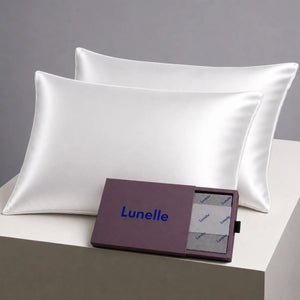
Lunelle 22 Momme Silk Pillowcase, Set of 2
A silk pillowcase in the 19 to 25 momme range provides the smooth, low-friction surface that actually reduces overnight hair stress. At 22 momme, the Lunelle pillowcase sits at the ideal balance point: substantial enough to be durable, fine enough to feel genuinely luxurious. The charmeuse weave creates the smooth surface that reduces friction at the hair shaft level, which is the benefit that the research supports and that no spray can replicate.
- 100% Grade 6A mulberry silk
- 22 momme weight, ideal balance of softness and durability
- Charmeuse weave for a smooth, low-friction surface
- OEKO-TEX certified, free from harmful chemicals
- Envelope closure
- Machine washable
- 60-night guarantee
How to use a spray safely on silk
If you have confirmed that a spray is silk-compatible and you want to use it as part of your bedtime routine, the following steps reduce the risk of damaging the fabric or irritating your skin.
Safe spray technique for silk pillowcases
- Check the brand's instructions first. Confirm that the product is explicitly stated as safe for silk or delicate fabrics.
- Patch test on an inconspicuous area of the pillowcase before using it regularly. Wait at least 24 hours to check for discolouration or texture change.
- Spray from a distance of at least 30 cm. A fine, even mist disperses better and deposits less concentrated product on any single area of fabric.
- Apply lightly. One or two quick passes is sufficient. Saturating the fabric increases the risk of residue build-up and spotting.
- Allow the pillowcase to dry fully before skin contact. For a spray used just before bed, a light application 10 to 15 minutes beforehand usually provides enough drying time.
- Wash the pillowcase at least weekly. Spray residue accumulates, even when invisible. Regular washing prevents build-up on the fabric and against your skin.
- If you develop any skin redness, itching, or irritation along the areas of pillowcase contact, discontinue the spray before assuming the cause lies elsewhere.
 How often should you wash a silk pillowcase?
The general guidance for pillowcases is weekly washing, and this applies to silk as much as it does to cotton. Your pillowcase collects oils, sweat, skin cells, hair product residue, and skincare product transfer every single night. If you use a pillow spray as well, you are also adding spray residue to that accumulation. More frequent use of a spray is an argument for more frequent washing, not less.
Expert Insight: Good Housekeeping recommends washing silk pillowcases as frequently as cotton ones, approximately once a week. For washing, it advises using a gentle cycle with cool water and a mild detergent made for silk or delicates, ideally in a mesh laundry bag to prevent abrasion. Machine washing on the correct setting is generally safe for silk; the main risks are high heat, harsh detergents, and vigorous agitation.
Source: Good Housekeeping, How to Wash Silk Pillowcases
| Situation | Recommended wash frequency |
|---|---|
| Normal daily use, no spray | Once a week |
| Using a pillow spray occasionally | Once a week |
| Using a spray nightly or using overnight hair or skin products | Every 3 to 4 days |
| Acne-prone or oily skin | Every 2 to 3 days |
| Heavy sweating or warm-weather sleeping | Every 2 to 3 days |
How to freshen a silk pillowcase between washes, without a spray
If you prefer to avoid the fragrance and fabric risk entirely but still want your pillowcase to feel fresh between washes, these approaches are lower-risk and work well for most people.
Air it out. After sleeping, pull the pillowcase off the pillow and lay it flat, or hang it briefly in a well-ventilated room. Overnight moisture and warmth are the main contributors to that slightly stale bedding smell. A few hours of airflow makes a meaningful difference.
Use a pillow protector underneath. A removable pillow protector can be laundered more frequently than the silk pillowcase itself, which keeps both cleaner for longer. The silk case goes over the top and stays fresher as a result.
Spray the room, not the pillow. If you want a lavender or relaxing scent at bedtime, a room spray or diffuser delivers the aromatherapy effect without any product making contact with the fabric. The pillow stays clean; your nose gets what it wanted.
Wash slightly more often. The most reliable way to have a pillowcase that smells fresh is to wash it regularly. Silk is machine washable on a gentle cycle; a three-to-four-day rotation is perfectly sustainable and does not damage the fabric if you use the correct settings.
The only upgrade that genuinely changes your morning

Your silk pillowcase does the work. The spray is optional.
A smooth, low-friction surface is the one bedtime change that research actually supports. No fragrance required.
Also available: 30 Momme Silk Pillowcase, Set of 2 →
Grade 6A mulberry silk. OEKO-TEX certified. 60-night guarantee.
Frequently asked questions

Can you spray a silk pillowcase with a pillow spray?
Some pillow sprays are compatible with silk; many are not. Check the specific product's guidance before use. Several mainstream brands, including This Works and Febreze, explicitly advise against spraying their products onto silk or delicate fabrics. If a product's instructions do not confirm silk compatibility, treat it as unsuitable.
What pillow spray is safe for silk?
Silk-specific textile care sprays are the safest category. Some dedicated sleep-ritual pillow mists also confirm silk compatibility (NytEase is one example that does so explicitly). The key is to read the brand's own guidance rather than relying on the product's aesthetic or marketing positioning.
Will a pillow spray damage silk?
It depends on the spray. High-alcohol formulas can disrupt silk's protein structure over time. Heavily fragranced sprays may leave a residue that builds up with repeated use and dulls the fabric's lustre. Sprays not formulated for delicate fabrics can cause water spotting on silk. Use silk-compatible products only, and wash the pillowcase weekly to prevent residue accumulation.
Is pillow spray safe for sensitive or acne-prone skin?
Fragrance is a leading cause of contact dermatitis, and prolonged contact with a fragranced surface significantly increases the risk of a reaction. For reactive, acne-prone, or eczema-prone skin, the American Academy of Dermatology recommends fragrance-free bedding environments. If you have sensitised skin, spraying the room rather than the pillow is a safer approach.
Does pillow spray help you sleep?
It may contribute to a sleep routine. The U.S. National Center for Complementary and Integrative Health states that lavender aromatherapy may offer subjective wellbeing benefits for some people, but that the evidence for clinical sleep improvement remains unclear. A pillow spray is a sensory sleep cue, not a treatment for sleep difficulties.
Does pillow spray help hair?
No. The hair benefits associated with silk pillowcases come from reduced mechanical friction between the hair shaft and the fabric. That is a property of the fabric's smooth surface, not of anything applied to it. A fragrance spray on silk does not improve friction properties and provides no direct hair benefit.
Can I use a linen spray on a silk pillowcase?
Not all linen sprays are suitable for silk. Many commercial fabric refreshers warn against use on water-spot-prone fabrics, and silk falls into that category. A linen spray formulated for delicate fabrics, used lightly from a distance and allowed to dry fully, may be acceptable, but this is not the same as a linen spray in general. Check the specific product's compatibility first.
How often should I wash a silk pillowcase if I use a spray?
At least weekly, regardless of spray use. If you are using a spray nightly, every three to four days is more appropriate, because spray residue accumulates on the fabric and against your skin. Washing on a gentle cycle with cool water and a mild detergent made for silk is safe for most silk pillowcases.
What can I use instead of a pillow spray to freshen silk?
Airing the pillowcase out after each use is the most effective no-risk option. A room diffuser or spray delivers a similar sensory effect without product contacting the fabric. A pillow protector worn underneath keeps the silk case cleaner for longer between washes. Regular weekly washing is the single most reliable way to maintain a fresh-smelling silk pillowcase.
Can I use lavender essential oil directly on silk?
No. Undiluted essential oils can stain silk and leave residue that is difficult to remove. If you want a lavender scent, a room diffuser is far safer than applying any oil-based product to the pillowcase directly.
Does my pillowcase material affect how safe a spray is to use?
Yes, significantly. Silk is a protein fibre that reacts differently to chemical exposure than cotton or polyester. Products that are safe on synthetic or cellulose fabrics may not be safe on silk. Always identify a spray's compatibility with silk specifically, not with "delicate fabrics" as a general category, since brands define that term inconsistently.
Further Reading
Sources and References
- Sleep Foundation. Satin vs. Silk Pillowcase. sleepfoundation.org
- National Center for Complementary and Integrative Health. Lavender: Usefulness and Safety. nccih.nih.gov
- Mayo Clinic. Contact Dermatitis, Symptoms and Causes. mayoclinic.org
- Good Housekeeping. How to Wash Silk Pillowcases Without Damage. goodhousekeeping.com
- Skin + Me. Ask a Dermatologist: Do Silk Pillowcases Prevent Wrinkles? skinandme.com
- Hamilton, D.L. Methods of Conserving Archaeological Material from Underwater Sites. Texas A&M University Center for Maritime Archaeology and Conservation. nautarch.tamu.edu
- PMC / NCBI. The "Maskne" Microbiome, Pathophysiology and Therapeutics. pmc.ncbi.nlm.nih.gov
- Encyclopaedia Britannica. Silk. britannica.com
- American Academy of Dermatology. Contact Dermatitis Overview. aad.org