
What Is a Standard Size Pillowcase? Dimensions and Fit Guide
Lunelle Team
11 min read
A standard pillowcase in the US is 20 x 26 inches. A queen is 20 x 30 inches. A king is 20 x 36 inches. If that is all you needed, those are your numbers.
You are buying a pillowcase. The listing says "standard." Your pillow might be queen-sized. You are not entirely sure. The page helpfully notes dimensions in inches, a separate measurement in centimetres, and possibly also the phrase "standard/queen," which sounds like it means both but could also mean neither.

Pillowcase sizing is genuinely more confusing than it needs to be, largely because "standard" is a widely used term that the bedding industry has never quite standardised. Brands measure slightly differently. The UK and US use entirely different definitions. And once you add silk pillowcases to the question, the terminology gets a little richer still.
This guide answers the core sizing question immediately, explains where the confusion comes from, and shows you how to choose the right pillowcase for your pillow regardless of what the listing calls it. It also covers why the material you choose matters as much as the size, once you have the dimensions sorted. For a broader view of what to look for when choosing a silk pillowcase, our ultimate guide to silk pillowcases for skin and hair covers the full buying picture.
Quick Answer
In the US, a standard pillowcase measures approximately 20 x 26 inches, designed to fit a standard pillow of the same dimensions. A queen pillowcase is 20 x 30 inches; a king is 20 x 36 inches. Many brands sell a "standard/queen" pillowcase that accommodates both standard and queen pillows. In the UK, a "standard" pillowcase is typically 50 x 75 cm (about 20 x 30 inches), which is closer to the US queen size.
Key Takeaways
- US standard pillow size is 20 x 26 inches. Queen is 20 x 30 inches. King is 20 x 36 inches. These are the three main sizes across the US market.
- Many brands sell a combined "standard/queen" pillowcase that fits both sizes, a useful option if you are not certain of your pillow's exact dimensions.
- UK "standard" usually means 50 x 75 cm, which is roughly equivalent to the US queen size. Check the actual centimetre or inch measurement rather than relying on the size name alone.
- Once you have the right size, material makes a significant difference to how your hair and skin feel after a night's sleep. A silk pillowcase in the correct size reduces friction compared to cotton at the same dimensions.
- Always check the product page for exact sewn dimensions, not just the size name. Brands cut their pillowcases slightly differently, and the difference of a few inches can mean a pillow that fits well or one that bunches uncomfortably.

In this article
- What are the US pillowcase sizes?
- Does a queen pillow fit a standard pillowcase?
- UK vs US sizing: why they are not the same
- How to measure your pillow
- Does material matter as much as size?
- Do silk pillowcases reduce sleep creases?
- The silk pillowcase upgrade
- How does your pillowcase affect hair?
- How to care for a silk pillowcase
- Frequently asked questions
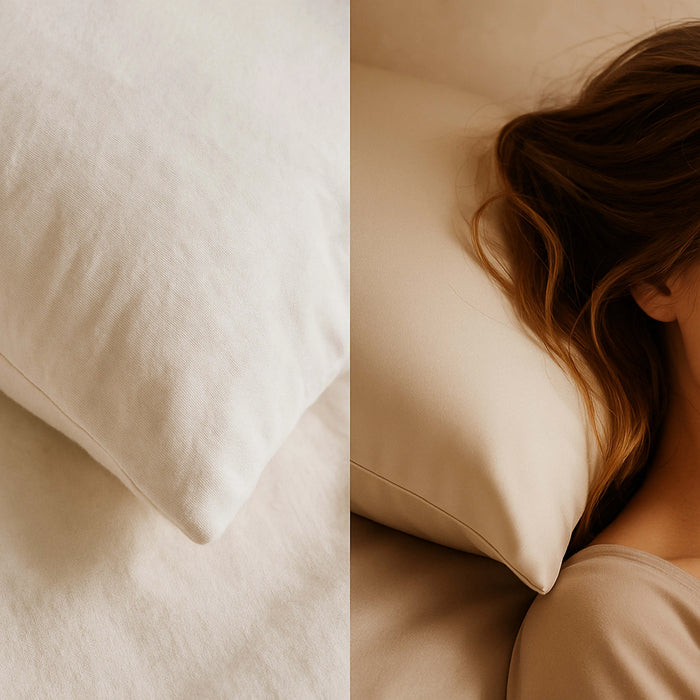
You came here about pillow sizes. The material was going to come up eventually.
Shop Now →What Are the Standard Pillowcase Sizes in the US?
In the US market, pillow and pillowcase sizes follow a broadly consistent pattern across major bedding brands, even if individual products are cut slightly differently.
| Size name | Typical pillow dimensions | Typical pillowcase dimensions | Best for |
|---|---|---|---|
| Standard | 20 x 26 inches | 20 x 26 inches (some brands add 1 to 2 inches for ease of fit) | Twin and full beds; single-sleeper queen beds |
| Standard/Queen | 20 x 26 to 20 x 30 inches | Typically 20 x 30 inches, designed to fit both standard and queen pillows | Anyone unsure of their exact pillow size; queen beds |
| Queen | 20 x 30 inches | 20 x 30 inches | Queen beds; side-sleepers who want more pillow coverage |
| King | 20 x 36 inches | 20 x 36 inches | King beds; European-style decorative arrangements |
The Sleep Foundation confirms that standard pillows are commonly listed at 20 x 26 inches, queen pillows at 20 x 30 inches, and king pillows at 20 x 36 inches. These are the numbers used across most major bedding brands, including Casper, Parachute, The Company Store, and Boll & Branch, though individual cuts vary slightly.

Does a queen-size pillow fit in a standard pillowcase?
Sometimes, yes. But whether it fits well is a different question.
Casper notes that queen pillows fit snugly inside a standard-size pillowcase, and that standard pillowcases are often marketed as versatile enough to accommodate queen pillows. In practice, a 20 x 30 inch queen pillow pushed into a 20 x 26 inch standard case will fit, but it will be a tight fit that stresses the seams and may cause the pillow to bunch at the closed end.
If your pillow is borderline between standard and queen, the simplest solution is to buy a "standard/queen" pillowcase. Most major brands now sell this combined size as a default. It accommodates both pillow dimensions comfortably, without the bunching or the guesswork.
Why Do UK and US Pillowcase Sizes Mean Different Things?
This is the part that trips up a significant number of online shoppers, particularly when buying from international retailers or comparing brands across markets.
In the UK, a "standard" pillowcase typically measures 50 x 75 cm, which converts to approximately 20 x 30 inches. That is the US queen size. A UK "standard" is not the same as a US "standard." If you purchase a UK-labelled "standard" pillowcase for a US standard pillow, it will be four inches longer than expected and will sit loosely on the pillow rather than fitting snugly.
| Market | Size name | Dimensions (cm) | Dimensions (inches) | US equivalent |
|---|---|---|---|---|
| US | Standard | 51 x 66 cm | 20 x 26 in | Standard |
| US | Queen | 51 x 76 cm | 20 x 30 in | Queen |
| UK | Standard | 50 x 75 cm | ~20 x 30 in | Queen |
| UK | King / Housewife | 50 x 90 cm | ~20 x 35 in | Approaches US king |
| EU | Standard | 65 x 65 cm | ~26 x 26 in | No direct equivalent (square) |
The safest approach when buying from any brand, regardless of market, is to check the actual centimetre or inch measurement listed on the product page rather than relying on the size name alone. The name is a starting point. The dimensions are the answer.
How to measure your pillow and find the right fit
If you are replacing an old pillowcase and want to make sure the new one fits, measuring the pillow takes about forty seconds and eliminates the most common source of bedding disappointment.
How to measure your pillow
- Lay the pillow flat on a surface without compressing it.
- Measure the length from one end to the other along the longest edge. This is typically between 26 and 36 inches in the US market.
- Measure the width along the shorter edge. This is usually around 20 inches for most pillow types.
- Note both measurements. If your pillow is 20 x 26 inches, buy a standard or standard/queen case. If it is 20 x 30 inches, buy a queen or standard/queen. If it is 20 x 36 inches, you need a king.
- Add a small allowance for fit: a pillowcase that is exactly the same size as the pillow will be difficult to put on. One to two inches of additional length is typical in a well-cut case.
One small note for silk pillowcase buyers: silk does not stretch the same way as cotton jersey or flannel, so an accurate fit matters slightly more. A well-fitted silk pillowcase sits smoothly over the pillow without puckering at the seams, which affects both comfort and appearance.
Does Pillowcase Material Matter as Much as Size?
Once you know which size fits your pillow, the material question is worth at least as much attention. Two pillowcases can be identically sized and produce very different results over the course of a night, because the fabric they are made from behaves completely differently against your hair and skin.
Silk has been valued as a textile for centuries, partly for the reasons Britannica notes: its strength, softness, smoothness, and moisture absorption properties distinguish it from most other fabrics. Understanding what mulberry silk actually is at the fibre level explains why it behaves so differently from polyester satin on the same pillowcase form. More relevant to how your pillow behaves overnight is what TRI Princeton, a textile research organisation, found when it measured friction between different fabrics and hair: silk produces a lower friction force than cotton under the same conditions. That result helps explain why the experience of sleeping on a silk pillowcase feels different from sleeping on a cotton one. The difference is measurable, not just perceptible.
Expert Insight: TRI Princeton's hair friction testing measures the force required to pull hair across a fabric surface as a direct indicator of friction between hair and textile. Its research found that silk produced lower friction force than cotton in these tests, providing a material basis for the widely-reported benefits of silk pillowcases for hair smoothness and reduced breakage.
Source: TRI Princeton, Everyone is Talking About: Silk Pillowcases
Expert Insight: The Sleep Foundation identifies 19 to 25 momme as the ideal weight range for a high-quality silk pillowcase, with Grade 6A mulberry silk representing the premium end of the raw silk quality scale. Momme is a measure of silk fabric weight, not thread count. A 22 momme pillowcase offers a practical balance of durability and softness.
Source: Sleep Foundation, Best Silk Pillowcases
Do Silk Pillowcases Actually Reduce Sleep Creases?
One of the more durable claims around silk pillowcases is that they can reduce sleep creases. The evidence here is more nuanced than a lot of silk marketing suggests, but the underlying mechanism is real.
Cleveland Clinic notes that sleep creases result from the way the head is positioned on the pillow throughout the night. Peer-reviewed research has linked the repeated compression, tension, and shear forces that occur during sleep to distortion in facial skin over time. The question is not whether these forces exist: they clearly do. The question is whether the pillowcase material meaningfully affects them.
A silk pillowcase allows more glide between the skin and the fabric than a cotton one. That reduced friction means less shear force on the skin during repositioning overnight. Whether that translates into a clinically meaningful reduction in long-term wrinkle formation is a different and more complicated question. A dermatologist interview published by Skin + Me is direct about this: there is no solid evidence that simply switching to a silk pillowcase makes a meaningful anti-ageing difference on its own. The benefit is more accurately described as reduced overnight friction, which is a real and useful property rather than a cosmetic cure.
Expert Insight: Skin + Me dermatologists note that while silk pillowcases are unlikely to prevent wrinkles on their own, they can reduce overnight friction and skin tugging, which is particularly relevant for people with dry or reactive skin. The most evidence-backed benefit is comfort and reduced mechanical stress, not a reversal of skin ageing.
Source: Skin + Me, Ask a Dermatologist: Do Silk Pillowcases Prevent Wrinkles?
The silk pillowcase upgrade: choosing the right size and material together
The problem: you have measured your pillow, you know your size, and you are sleeping on a cotton pillowcase that creates friction against your hair and skin for seven or eight hours every night. That friction is cumulative. Over weeks and months, it contributes to the frizz, the tangles, the overnight crease lines, and the general sense that your bedding is working against your grooming routine.
The solution: a pillowcase in the right size, in a material that reduces friction rather than creating it.
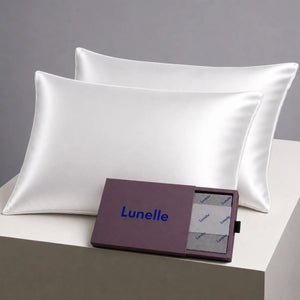
Lunelle 22 Momme Silk Pillowcase, Set of 2
At 22 momme, the Lunelle pillowcase sits at the sweet spot the Sleep Foundation identifies as ideal for quality and durability. For a full explanation of how momme count affects silk quality and what to look for at different price points, the fabric reference guide covers this in detail. The charmeuse weave creates the smooth, low-friction surface that is the primary reason silk pillowcases feel and perform differently from cotton ones. Grade 6A mulberry silk is the highest grade available for raw silk, and OEKO-TEX certification means no harmful chemicals are present in the fabric that will be in contact with your skin overnight.
- 100% Grade 6A mulberry silk
- 22 momme weight, the ideal balance of softness and durability
- Charmeuse weave for a smooth, low-friction surface
- OEKO-TEX certified, free from harmful chemicals
- Envelope closure
- Machine washable
- 60-night guarantee
How Does Your Pillowcase Affect Your Hair?
Pillowcase material affects hair for the same reason it affects skin: friction. Hair cuticles are the outermost layer of the hair shaft, and their condition determines how hair looks and feels. Research published in peer-reviewed journals on hair care describes how physical stressors, including friction, contribute to cuticle disruption and hair weathering over time. A hair shaft with a disrupted cuticle is more prone to tangling, breakage, and frizz.
For anyone with curly or coily hair, the stakes are higher. The American Academy of Dermatology recommends reducing friction against pillowcases to help preserve curl pattern and reduce breakage, specifically mentioning satin or silk as suitable materials. For chemically treated hair, extensions, or hair that is already fragile, the nightly friction from a cotton pillowcase is adding stress to a surface that is already under pressure. The best pillowcase for hair depends partly on hair type, and the dedicated guide covers which materials and specifications matter most for different needs.
Expert Insight: Research published in the International Journal of Cosmetic Science describes hair weathering as a cumulative process driven by a combination of physical and cosmetic stressors. Friction is among the physical contributors. Hair that experiences repeated friction against rough surfaces shows more cuticle disruption than hair kept in lower-friction environments, which over time affects its appearance, manageability, and integrity.
Source: PMC / NCBI, On Hair Care Physicochemistry
How Do You Wash and Care for a Silk Pillowcase?
Silk is more washable than its reputation suggests. Many silk pillowcases, including those at 22 momme and above, can be machine washed on a gentle or delicate cycle. The key variables are water temperature, agitation, and detergent choice.
Expert Insight: Good Housekeeping advises washing silk pillowcases as often as cotton ones (approximately once a week), using cool water on a gentle cycle, a mild detergent formulated for silk or delicates, and a mesh laundry bag to prevent abrasion. High heat is the main risk: it can damage the protein structure of silk fibres. Air drying is recommended over tumble drying.
Source: Good Housekeeping, How to Wash Silk Pillowcases
The other thing worth knowing, as Good Housekeeping confirms, is that silk should not be washed with standard laundry detergent. If you want the balanced picture before buying, the disadvantages of silk pillowcases are worth reading alongside the benefits. Standard detergents are often alkaline, typically with a pH of 9 to 11. Silk is a protein fibre and begins to degrade in alkaline conditions. A mild, pH-neutral detergent specifically formulated for silk or delicates is the correct choice, and it will extend the life of the pillowcase significantly.

Now that you have the right size, get the right material
The correct size and the correct material. Finally.
Available in standard, queen, and king. 22 momme Grade 6A mulberry silk with a 60-night guarantee.
Also available: 30 Momme Silk Pillowcase, Set of 2 →
Charmeuse weave. OEKO-TEX certified. Measurably lower friction than cotton.

Frequently asked questions

What is the standard pillowcase size in the US?
In the US, a standard pillowcase measures approximately 20 x 26 inches, fitting a standard pillow of the same dimensions. This is the most common size sold by major US bedding brands.
Is a standard pillowcase the same as a queen pillowcase?
No. A standard pillowcase is typically 20 x 26 inches; a queen pillowcase is 20 x 30 inches, which is four inches longer. However, many brands sell a "standard/queen" pillowcase that accommodates both sizes comfortably. A queen pillow can be pushed into a standard case, but it will be a snug fit.
What is a standard pillowcase size in the UK?
In the UK, a "standard" pillowcase is typically 50 x 75 cm, which converts to approximately 20 x 30 inches. This is equivalent to the US queen size, not the US standard. When buying across markets, always check the actual measurements rather than the size name.
What size pillowcase fits a queen pillow?
A queen pillowcase (20 x 30 inches) is designed for a queen pillow. A standard/queen pillowcase will also fit a queen pillow comfortably. A standard pillowcase (20 x 26 inches) can technically fit a queen pillow but will be a tight fit.
How do I know if my pillow is standard or queen?
Measure it. A standard pillow is 20 x 26 inches; a queen pillow is 20 x 30 inches. If the length is between 26 and 30 inches, a standard/queen pillowcase will fit either. If you cannot measure it, check the pillow's original packaging or look for a label inside the seam.
Do silk pillowcases come in standard size?
Yes. Silk pillowcases are available in standard, queen, and king sizes, following the same size conventions as cotton pillowcases. Some brands list a combined standard/queen size. Always check the exact dimensions on the product page before purchasing.
Does pillowcase size affect hair or skin benefits from silk?
No. The hair and skin benefits of silk come from the fabric's smooth, low-friction surface, which is a property of the material rather than its size. A correctly sized silk pillowcase will sit smoothly over the pillow, which ensures consistent fabric contact. An ill-fitting case that bunches or pulls may reduce the smoothness benefit.
Is a silk pillowcase better than cotton for hair?
The evidence supports a practical benefit: silk produces less friction against hair than cotton, which can reduce tangling, frizz, and overnight cuticle stress. The American Academy of Dermatology recommends silk or satin pillowcases specifically for people with curly hair or fragile hair. The benefit is friction reduction, not a cosmetic treatment.
How often should I wash a silk pillowcase?
About once a week, which is the same frequency recommended for cotton pillowcases. Silk should be washed on a gentle or delicate cycle with cool water and a pH-neutral detergent made for silk or delicates. Air drying is recommended over tumble drying, as heat can damage silk fibres.
What momme weight is best for a silk pillowcase?
The Sleep Foundation recommends 19 to 25 momme as the ideal quality range for a silk pillowcase. At 22 momme, a pillowcase offers a strong balance of softness and durability. Higher momme weights (25 to 30) are more substantial and longer-lasting; lower weights may feel lighter but are less durable over time.
Can I use a standard pillowcase on a queen bed?
Yes, though it will leave more of the pillow exposed at the closed end. On a queen bed with queen-sized pillows, a standard pillowcase will fit snugly but may look slightly shorter than expected. For a tidier appearance, a queen or standard/queen pillowcase is a better fit.
Further Reading
Sources and References
- Sleep Foundation. Pillow Sizes and Dimensions. sleepfoundation.org
- Sleep Foundation. Best Silk Pillowcases. sleepfoundation.org
- Casper. Pillowcase Size Chart and Dimensions Guide. casper.com
- Britannica. Silk: Definition and History. britannica.com
- TRI Princeton. Everyone is Talking About: Silk Pillowcases. triprinceton.org
- PMC / NCBI. On Hair Care Physicochemistry: From Structure and Degradation to Novel Biobased Conditioning Agents. pmc.ncbi.nlm.nih.gov
- Cleveland Clinic. What You Need to Know About Ageing Skin. health.clevelandclinic.org
- Skin + Me. Ask a Dermatologist: Do Silk Pillowcases Prevent Wrinkles? skinandme.com
- Good Housekeeping. How to Wash Silk Pillowcases. goodhousekeeping.com
- American Academy of Dermatology. Curly hair care tips from dermatologists. aad.org
- Purple. Pillow Size Guide: Standard, Queen, and King Dimensions. purple.com