
Heatless Curls Overnight: 7 Methods That Actually Work
If you want soft waves without frying your ends over a hot barrel, heatless curls overnight are the answer, and they genuinely work once you understand the one rule everyone gets wrong. The idea is simple: wrap damp hair around something soft, sleep, and unwrap curls in the morning. The execution is where most people trip up, usually by starting too wet or unwrapping too soon.
This guide covers the science of why no heat curls hold, seven methods that actually deliver, a foolproof step-by-step routine, and the mistakes that make your set collapse by breakfast. We will also settle the silk-versus-satin question honestly, and tell you which method suits your hair length and texture.

Quick Answer
Heatless curls overnight are waves set by wrapping damp hair around a soft rod, ribbon, sock, or braid, then leaving it to dry as you sleep. It works because water lets your hair's hydrogen bonds re-form in a curved shape. Start damp, not soaking, let hair dry completely, and results usually last one to three days.
Key Takeaways
- Heatless curling relies on the wet-set principle: damp hair dried in a curl re-forms its hydrogen bonds in that shape.
- Start with damp hair (roughly 70 to 80 percent dry) and never unwrap before it is completely dry, or the curl drops instantly.
- Seven methods work: heatless rods, silk ribbon curls, sock curls, braids, twists, flexi rods, and foam rollers.
- No heat means no thermal damage, the main advantage over irons and wands.
- A smooth silk or satin surface reduces overnight friction and frizz, but fabric will not transform hair health on its own.
- Curls last one day on fine hair and up to three on thick or coarse hair; humidity is the enemy.
In This Article
- What are heatless overnight curls?
- How does heatless curling actually work?
- 7 heatless curls overnight methods that work
- Step-by-step: the overnight rod and ribbon method
- The overnight friction problem no method fixes
- Silk vs satin vs cotton: which material?
- How long do heatless curls last?
- Heatless vs heated curling
- Common heatless curl mistakes
- Expert guidance and safety notes
- Frequently asked questions
What are heatless overnight curls?
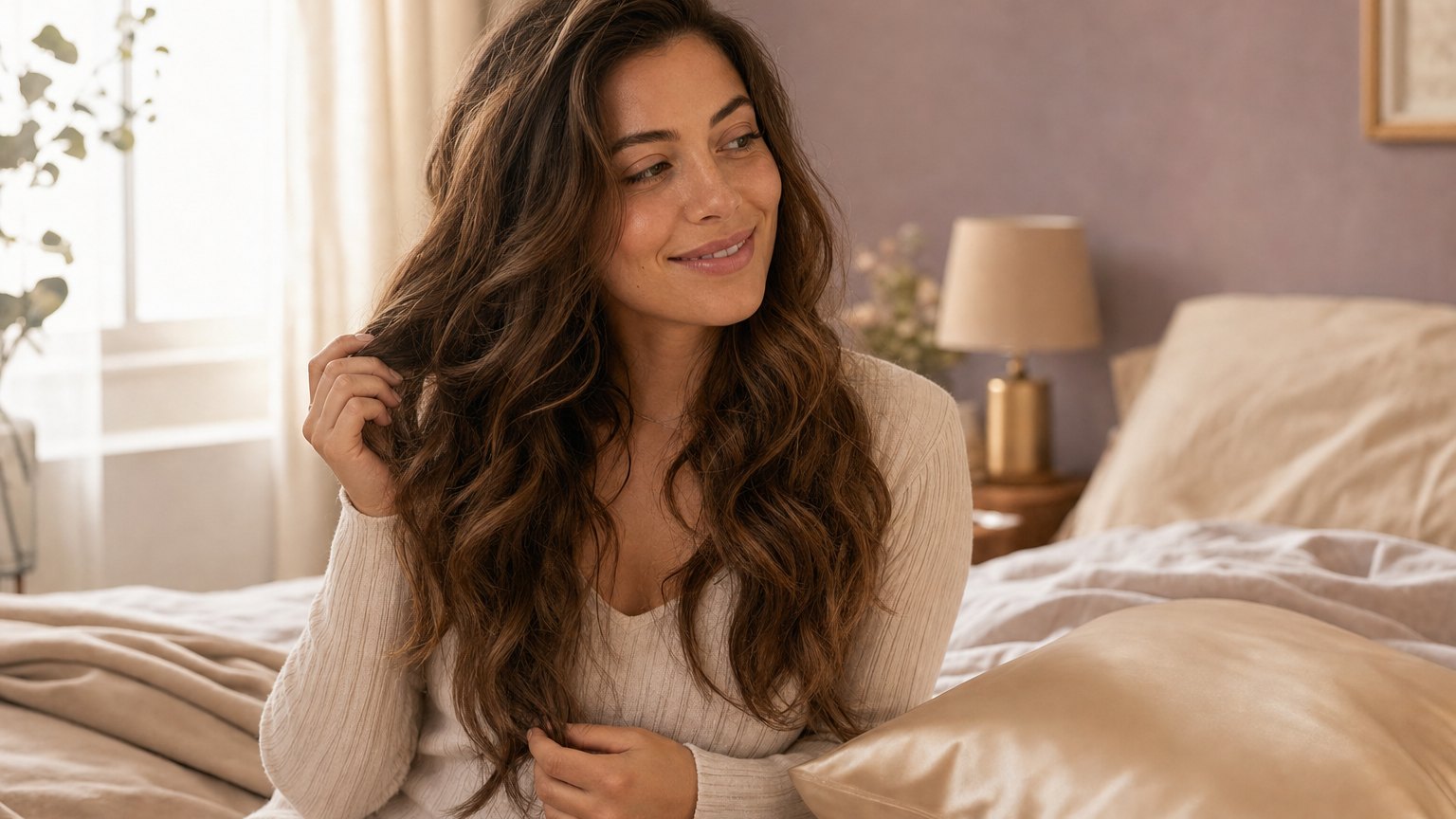
Heatless overnight curls are waves or ringlets created by wrapping damp hair around a soft, flexible object and leaving it to dry and set while you sleep. No curling iron, wand, or hot tool is involved at any stage.
The object can be a padded fabric rod, a length of silk ribbon, a rolled sock, a dressing-gown belt, or simply your own hair in braids or twists. You wrap in the evening, sleep six to eight hours, then unwrap soft, tool-free curls in the morning.
Because heat never touches the hair, the technique avoids the thermal stress associated with irons. That is the whole appeal of no heat curls: a style that sets passively overnight while doing your strands no favours and no harm.
Expert Insight: The American Academy of Dermatology advises limiting heat styling and using gentler alternatives to reduce cumulative damage on fragile or chemically treated hair, which is exactly the niche heatless curling fills.
Source: American Academy of Dermatology
How does heatless curling actually work?
Heatless curling works through the wet-set principle: when hair is wetted and dried in a curved position, the weak hydrogen bonds inside each strand re-form in that new shape and hold until the hair gets wet or humid again. It is the same physics a curling iron uses, minus the heat.
Your hair holds its shape through two bond types. Disulfide bonds are strong, permanent links that set your natural curl pattern and only change through chemical services such as perms. Hydrogen bonds are weak and temporary, breaking when hair is wet and re-forming as it dries.
Heatless and heated styling both exploit those hydrogen bonds. You make the fibre pliable, shape it, then lock the shape in as it dries or cools. Cosmetic-chemistry explainers such as The Beauty Brains describe this wet-set mechanism as the basis of all temporary styling.
This is why two rules are non-negotiable. First, start with damp hair, because water is what makes the bonds re-formable. Second, let the set dry completely before unwrapping, because unwrapping while damp releases the curl before the bonds have locked.
Expert Insight: Reviews of hair structure and mechanical behaviour, including work published in the International Journal of Trichology via the NCBI archive, note that hair is at its weakest and most stretchable when wet, so damp hair should be handled gently while wrapping.
Heatless curling is not a hack so much as basic hair physics that patient people have always known about.
7 heatless curls overnight methods that work
Seven heatless methods reliably produce overnight curls, and the right one depends on your hair length, texture, and how defined you want the result. Here is what each delivers and where each falls short.
1. Heatless curling rod (or robe belt)
A long padded fabric tube sits over the head like a headband, and damp hair is wrapped around each side in overlapping sections. This is the most popular overnight method and gives soft, even, spiral-to-wave curls with root volume if wrapped high. A dressing-gown belt improvises the same effect. Watch out for kinks from wrapping too tightly and straight tips if you leave the ends out.
2. Silk ribbon curls
Silk ribbon curls use lengths of ribbon the same way as classic rag roll curls: lay a damp section against the ribbon, roll it up, and tie the ends. Ribbon is thin and soft, so it is comfortable to sleep on and can create tighter, more defined ringlets than one thick rod. It takes longer because you tie many individual sections. Our silk ribbon hairstyle tutorial walks through elegant variations that are gentle on hair.
3. Sock curls overnight
Sock curls wrap damp hair around a rolled clean sock, either in individual sections or gathered into a sock bun doughnut. It is the cheapest, most accessible version of the rod method and produces relaxed beach-wave texture. The trade-off is a less uniform result than a purpose-made rod. It is also the method you can execute at midnight with zero prep, which is a significant part of the appeal.
4. Braids for heatless waves overnight
Braiding damp hair is the lowest-effort route to heatless waves overnight. One loose braid gives soft bends; several tighter braids give crimped, zigzag waves. It is the ideal beginner method and works beautifully on very long hair. Expect a crimped texture rather than a rounded ringlet. People have been doing this for centuries without calling it a technique, which is either reassuring or deflating depending on your outlook.
5. Two-strand twists
Twisting damp hair into two-strand sections and unravelling in the morning creates a soft, natural S-wave. Twists suit medium to thick hair and are quicker than braids. Fewer, chunkier twists give looser waves; many thin twists give a tighter, more defined pattern.
6. Flexi rods overnight
Flexi rods are bendable foam-and-wire rods that set a controlled curl size overnight, where a smaller rod means a tighter curl. They are a favourite in curly and textured-hair communities because the curl size is predictable. Some versions are firm and can feel intrusive to sleep on.
7. Foam rollers
Soft foam rollers give sized, bouncy curls with more structure than a sock. They are gentle enough for overnight wear if you choose the softer, cushioned kind. Firm rollers can be uncomfortable, so match the roller to how you sleep.
Expert Insight: Beauty editors at Byrdie consistently rank overnight rods, braids, and rag-roll ribbon sets as the most reliable no-heat curling routines for at-home use, praising them for combining minimal effort with genuine hold.
Source: Byrdie hair how-to editorial
Step-by-step: the overnight rod and ribbon method
The overnight rod or ribbon method is the most dependable heatless curl technique, and the steps are the same whether you use a purpose-built rod, a silk ribbon, or a dressing-gown belt you found at the back of a drawer. Ten minutes of preparation before bed, and you wake up to curls that have genuinely done the work while you slept.
- Start with clean-ish hair. Day-old hair often grips a set better than freshly washed, slippery hair. If your hair is dry, mist it with water until evenly damp.
- Towel to damp. Aim for roughly 70 to 80 percent dry: damp to the touch, no dripping. This single variable decides whether your hair dries overnight.
- Apply a light styling product. A mousse, sea-salt spray, curl cream, or setting lotion helps the curl hold. Skip heavy oils, which stop hair drying.
- Detangle and section. Part hair down the middle and work with two to four sections per side.
- Position the rod or ribbon. Place a rod over the crown like a headband, or start each ribbon high near the root.
- Wrap consistently. Cross each section over the rod and wrap in one direction all the way to the ends, so no tips are left out.
- Secure. Fasten with a scrunchie or claw clip, or tie the ribbon ends.
- Protect for sleep. A silk bonnet or silk pillowcase reduces friction and frizz overnight.
- Dry fully. Sleep six to eight hours; hair must be bone-dry before you unwrap.
- Unwrap and finish. Gently unwind, separate curls with your fingers, and set with a flexible-hold spray. Avoid heavy brushing, which turns curls into frizz.
The overnight friction problem no method fixes
The problem: even a perfect heatless set spends the night rubbing against your pillow, and a rough cotton surface drags on the cuticle, roughing up the curl and inviting frizz. Hair-science research confirms that friction rises as hair becomes more weathered or chemically processed, so the strands you most want to protect are the ones that snag worst.
The solution: a pillowcase that lets your set glide instead of catch. A smooth surface reduces overnight cuticle drag, helps a fresh curl keep its shape, and keeps any leave-in product in your hair rather than the fabric. The Sleep Foundation notes that silk is gentler on hair than cotton because its smooth texture lets strands slide with less snagging, and the American Academy of Dermatology recommends a silk or satin surface to help hold a style and reduce friction, breakage, and frizz.

Silk vs satin vs cotton: which material for heatless curls?
For heatless curls, a smooth fabric (silk or satin) beats cotton for comfort and frizz control, but the smoothness matters more than the label. Silk is a natural protein fibre; satin is a weave that can be made from polyester or silk, so quality varies widely between satin products.
What is reasonably supported: smoother surfaces create less friction than cotton, which can reduce frizz, tangling, and overnight cuticle abrasion, and they absorb less moisture from damp hair. What is weakly supported: claims that silk specifically prevents breakage or keeps curls healthier than good satin are largely brand claims rather than firm trial evidence. Choose smoothness first, and treat fabric as one helpful factor, not a miracle.
| Property | Silk | Satin (polyester) | Cotton |
|---|---|---|---|
| Surface friction | Lowest | Low, varies by quality | Highest, more cuticle drag |
| Moisture absorbency | Low, treatments stay in hair | Low to moderate | High, draws moisture out |
| Breathability | Excellent | Lower, can feel warm | Good |
| Static | Low | Higher, especially fine hair | Low |
| Durability | 3 to 5 years with care | 1 to 2 years | 1 to 2 years |
| Verdict | Best overall for hair | Solid budget upgrade over cotton | Fine to sleep on, not ideal for curls |
If budget is the deciding factor, a quality polyester satin pillowcase is a genuine improvement over cotton and a sensible start. If you want the fuller upgrade, 100 percent mulberry silk addresses more variables at once. For a deeper comparison, our guide on whether satin is good for hair covers exactly where the weave stops and the fibre starts.
Expert Insight: The Cleveland Clinic advises that a silk pillowcase can help hair retain moisture and reduce friction overnight, a fair summary of the physical case for silk without overstating the health claims.
Source: Cleveland Clinic
How long do heatless curls last?
Heatless curls typically last one to three days, and how long depends heavily on your hair type. Fine or straight hair often holds for a day and may drop by evening; medium hair holds one to two days; thick or coarse hair can hold two to three.
Longevity comes down to three things: how completely the hair dried, the humidity in the air, and whether you used product. Moisture in the air re-breaks hydrogen bonds and relaxes the set, which is why high humidity is the single biggest enemy of any wet-set style. No reliable published figure was available for average curl duration, so treat these ranges as practical estimates, not lab data.
To extend a set, sleep in a loose pineapple or bonnet, refresh with a little dry shampoo or curl-revive spray, and resist over-touching. A silk scrunchie holds a high loose ponytail without denting the shape.
Expert Insight: Hair editors at Allure recommend finishing an unwrapped set with a flexible-hold product and finger-separating rather than brushing, which preserves definition and stretches how long the curls stay crisp.
Source: Allure hair guides
Heatless vs heated curling: which should you choose?
Choose heatless curling if you value hair health and low effort, and heated curling if you need precise, uniform curls fast. Heatless wins on damage and cost; the iron wins on speed and precision. Neither is objectively better; they solve different priorities.
| Factor | Heatless overnight | Curling iron or wand |
|---|---|---|
| Hair damage risk | Low, no thermal damage | Higher, cumulative heat damage |
| Active time | Low, long passive set | Short total time |
| Curl precision | Softer, less uniform | Precise and uniform |
| Longevity | 1 to 3 days, humidity-sensitive | Often crisper, also humidity-sensitive |
| Cost | Very low, can improvise | Tool cost plus ongoing heat exposure |
| Verdict | Best for damage-prone or low-effort routines | Best for fast, engineered curls |
The iron gives you a curl tonight; the overnight set gives you a curl and your cuticle back.
Common heatless curl mistakes (and why yours fell out)
The most common reason heatless curls fall out immediately is unwrapping before the hair was completely dry, which releases the curl before the hydrogen bonds have set. Fix that first, then check these other culprits.

- Hair too wet. Soaking hair never dries overnight, so the curl falls flat. Aim for damp, not dripping.
- Hair too dry. Bone-dry hair will not take a set at all; mist it first.
- Wrapping too loosely. The curl slips out. Wrap snug but not painful.
- Wrapping too tightly. You get kinks and a poor night's sleep.
- Leaving the ends out. This gives straight, fishhook tips on curly lengths.
- Over-brushing after unwrapping. Defined curls turn to frizz. Finger-separate instead.
- Heavy oils or creams. These stop hair drying, so the set never locks.
Before you curl: quick checks
- Your hair is damp, not soaking, and not bone-dry.
- You can commit six to eight hours of drying time before you unwrap.
- You have a light setting product to hand (mousse, sea-salt spray, or curl cream).
- You have a soft tool that suits your length: a rod or ribbon for long hair, small rollers or ribbon for short.
- You are willing to protect the set with a bonnet or a smooth silk pillowcase.
- Your expectations are set for soft, natural waves rather than engineered ringlets.
Tick those and you are set. Most heatless curl disappointments trace back to number two — hair that was still damp when you unwrapped — or number six, expecting polished ringlets when the method delivers soft, natural waves.
Expert guidance and safety notes
Heatless curls are low-risk when kept gentle, and their headline advantage is the total absence of thermal damage. The residual risks are mechanical, not thermal, and they are easy to avoid once you know them.
Handle damp hair gently. Hair is weakest and most stretchable when wet, so tugging tight sections while wrapping can cause mechanical breakage. Keep sets snug rather than tight, and vary where you position them from night to night. Chronically tight, repeated styles are associated with tension on the hair and scalp, so comfort matters.
Mind persistently wet hair too. Going to bed with genuinely soaking hair for many nights can, for some people, encourage scalp irritation, which is another reason damp is the target rather than wet. For a wider view of overnight hair protection, our guide to whether a silk pillowcase actually works for hair covers the friction science in depth.
Expert Insight: The American Academy of Dermatology warns that repeatedly wearing hair pulled tight is linked to traction alopecia, so heatless sets should never feel painful and placement should be varied over time.
Source: American Academy of Dermatology
Expert Insight: Textured-hair specialists at NaturallyCurly recommend flexi rods, small rollers, and many small braids for shorter or tightly textured hair, where a single long rod struggles to grip.
Source: NaturallyCurly
A denser silk option for heavier routines
The problem: if you set heatless curls most nights, wash your pillowcase often, and want a more substantial, hotel-weight feel, a lightweight silk can start to show wear sooner than you would like.
The solution: a heavier momme weight that offers the same low-friction surface with more density and longevity, ideal for frequent stylers who treat their pillowcase as working kit.

Protect the curls you worked for
A smooth mulberry silk pillowcase reduces overnight friction so your heatless set survives the night with less frizz. Try it for 60 nights, risk-free.
Shop the Collection →Free delivery · 60-night guarantee · Set of 2

Frequently Asked Questions: Heatless Curls Overnight
Do heatless curls actually work on straight hair?
Yes, heatless curls work on straight hair, though fine straight hair holds the shortest. Ensure the hair is properly damp, use a setting product such as mousse or sea-salt spray, and let it dry fully before unwrapping. Expect soft waves that may need re-setting daily.
Should hair be wet or dry for overnight heatless curls?
Damp, roughly 70 to 80 percent dry with no dripping. Water lets the hydrogen bonds re-form in the curled shape as the hair dries. Hair that is too wet will not dry overnight and drops flat; bone-dry hair will not take a set at all.
Why did my heatless curls fall out immediately?
The most common cause is unwrapping before the hair was completely dry, which releases the curl before the bonds set. Hair that started too wet to dry overnight, high humidity relaxing the set, or skipping product will also cause an instant drop.
How long should I leave heatless curls in?
Leave heatless curls in overnight, about six to eight hours, so the hair dries completely. A daytime version works only if you leave it until fully dry, which can take several hours depending on hair thickness and how damp you started.
Are silk ribbon curls better than a robe belt or sock?
Silk ribbon curls mainly change curl size, definition, and comfort, not hair health. Thin ribbon gives tighter, more defined ringlets and is comfortable to sleep on; a thick rod or robe belt gives looser waves. Choose by the result and comfort you want.
Is silk really better than satin for hair?
For reducing friction and frizz, smoothness matters more than whether the fabric is genuine silk. Both silk and quality satin are smoother than cotton. Silk, a natural fibre, also breathes better and lasts longer, but claims that it uniquely improves hair health are weakly evidenced.
Do heatless curls damage hair?
Heatless curls avoid thermal damage, which is their main advantage over irons. The residual risks are mechanical: handling fragile wet hair roughly, or wearing very tight sets repeatedly. Kept gentle and never painful, heatless methods are considered low-risk by dermatology guidance.
How do I make heatless curls last longer?
Dry the hair completely before unwrapping, set with a light product, and finish with flexible-hold spray. Protect the set with a bonnet or smooth silk pillowcase, refresh with a little dry shampoo, and avoid over-touching and high humidity where you can.
Can I do heatless curls on short hair?
Yes, but it is harder because there is less length to wrap. Use smaller tools such as flexi rods, small foam rollers, thin ribbon, or many small braids rather than one long rod. Smaller sections give the grip short hair needs.
What products help with heatless curls?
Light mousse, sea-salt spray, curl cream, or setting lotion help the curl hold, and a flexible hairspray finishes the look. Avoid heavy oils and thick creams, which coat the hair and stop it drying, so the set never fully locks.
Can I do heatless curls without washing my hair?
Yes, and day-old hair often holds a set better than freshly washed, slippery hair. Simply mist the hair with water until evenly damp before wrapping. If it feels greasy at the roots, a little dry shampoo helps the curl grip and lift.
Do heatless curls work on thick or coarse hair?
Yes, and thick or coarse hair often holds a heatless set the longest, up to two or three days. The trade-off is drying time: thicker hair needs to be closer to damp than wet, and may benefit from smaller sections to dry evenly overnight.
Further Reading
Sources and References
- American Academy of Dermatology. Hair care and hairstyling guidance. aad.org
- Sleep Foundation. Benefits of a silk pillowcase. sleepfoundation.org
- Cleveland Clinic. Silk pillowcase benefits for hair and skin. clevelandclinic.org
- International Journal of Trichology. Hair cosmetics and hair fibre mechanics (NCBI archive). ncbi.nlm.nih.gov
- The Beauty Brains. Cosmetic chemistry of temporary hair styling and the wet-set principle. thebeautybrains.com
- Byrdie. Heatless curl methods and how-to guides. byrdie.com
- Allure. Heatless curl and no-heat styling guides. allure.com
- NaturallyCurly. Flexi rods, rollers and braid sets for textured and short hair. naturallycurly.com