
Hair Care Routine for Growth: The Daily Habits That Actually Keep Your Length
If you feel like your hair has been the same length for years, you are not imagining it. But you are also almost certainly not failing at anything. Your hair is growing. It is just refusing to survive long enough to prove it.
Growth happens deep in the follicle at a pace set mostly by your genes, age, and health, none of which are listening to your supplement budget. What your routine can genuinely change is how much of that new length survives daily life, and whether your scalp stays a hospitable place for follicles to do their thing undisturbed.
This guide walks through the follicle cycle, the dermatologist-aligned daily steps, the honest truth about scalp massage and biotin (spoiler: mixed, at best), the treatments that actually work for real thinning, and realistic timings; so you can stop chasing miracles and start keeping the length you already grow.
Quick Answer
The most effective hair care routine for growth protects the hair you already grow rather than trying to speed up the follicle. Cleanse the scalp gently, condition and detangle with care because wet hair breaks easily, limit heat, and match washing frequency to your hair type. Scalp massage may help modestly; biotin only helps if you are deficient. For real thinning, minoxidil is the proven option.
Key Takeaways
- Hair grows at a genetically set rate; no product accelerates a healthy follicle, so preventing breakage is the highest-leverage move for visible length.
- Match washing frequency to how oily your scalp gets, cleanse the scalp rather than the lengths, and condition after every wash.
- Wet hair is fragile: detangle with a wide-tooth comb from the ends up, and limit heat styling to protect length.
- Scalp massage has small, promising evidence; biotin only helps if you are genuinely deficient and can distort lab tests at high doses.
- For pattern thinning, topical minoxidil is the best-supported option and needs several months of consistent use.
- A silk pillowcase reduces overnight friction and breakage, helping you retain length, but it does not treat medical hair loss.
In This Article
- What actually drives hair growth
- The growth cycle and why faster has limits
- The dermatologist-aligned daily routine
- How often to wash by hair type
- Does scalp massage regrow hair?
- Should you take biotin for hair?
- Nutrition and lifestyle factors
- Where a silk pillowcase fits in
- Silk vs satin vs cotton
- Proven treatments for real thinning
- Realistic timings
- Frequently asked questions

What actually drives hair growth?
Hair growth is driven by follicles cycling through active growth phases at a rate set largely by your genetics, hormones, age, and overall health. No shampoo, oil, or supplement speeds up a healthy follicle the way advertising implies. Your follicle has never read a label and is not about to start.
What a smart routine genuinely does is two things. It reduces breakage and shedding so the hair you grow reaches its full length looking healthy, and it keeps the scalp in good condition so follicles can do their work uninterrupted.
Board-certified dermatologists frame proper hair care around health and preventing certain kinds of hair loss, not around accelerating growth. According to the American Academy of Dermatology, the way you wash your hair and the products you choose can make a real difference to hair health and can help leave hair looking healthier.
Expert Insight: The AAD notes that proper hair care can help prevent certain types of hair loss and keep hair looking healthier, with product choice and washing technique making a meaningful difference. Their "Tips for healthy hair" page is reviewed by board-certified dermatologists and continues to lead with these fundamentals.
Source: American Academy of Dermatology
Your hair is growing. It just needs you to stop snapping it off before it gets anywhere useful.
Why does faster growth have limits? The hair cycle explained
Hair grows in cycles, and those cycles cap how fast and how long your hair can get. Each follicle moves through an active growth phase, a short transition phase, and a resting phase before the hair sheds and a new one begins.
The active growth phase lasts roughly a few years for scalp hair, which is what sets your maximum possible length. Because that duration is genetically fixed, no routine can extend it in a healthy person. Your follicle is not waiting for permission from a serum.
Average scalp hair grows on the order of about a centimetre per month, and this rate is largely determined by factors you cannot buy your way past. When length seems stalled, the culprit is almost always retention, not a follicle strike. The hair grew. The bathroom floor took it back.
Expert Insight: DermNet, the dermatology reference maintained by clinicians, describes hair weathering as the gradual raising and roughening of the cuticle from heat, chemical processing, and mechanical stress, which produces dullness, split ends, and breakage that make hair appear to stop growing.
Source: DermNet, hair loss and hair shaft disorders
What does a dermatologist-aligned hair care routine for growth look like?
A dermatologist-aligned hair care routine for growth follows one principle: protect what you grow. The steps below come directly from AAD guidance and prioritise scalp health and breakage prevention over gimmicks.
Learn your hair type and buy for it
Choose products made for your specific hair type, whether it is fine, straight, coarse, curly, or tightly coiled. Per the AAD, matching products to hair type is the foundation, because the same shampoo can over-dry coily hair and under-clean an oily straight scalp.
Cleanse the scalp, not the lengths
Apply shampoo to your scalp rather than the full length of your hair. The AAD advises this because the scalp is where product, dead skin, and excess oil build up, while the mid-lengths and ends are the oldest, most fragile hair and dry out easily if scrubbed with shampoo.
Condition after every wash, placed by hair type
Use conditioner after every shampoo, because it moisturises, detangles, and improves slip. Apply it to the ends if your hair is fine or straight, and along the entire length if your hair is dry or curly, following AAD placement guidance.
Handle wet hair gently
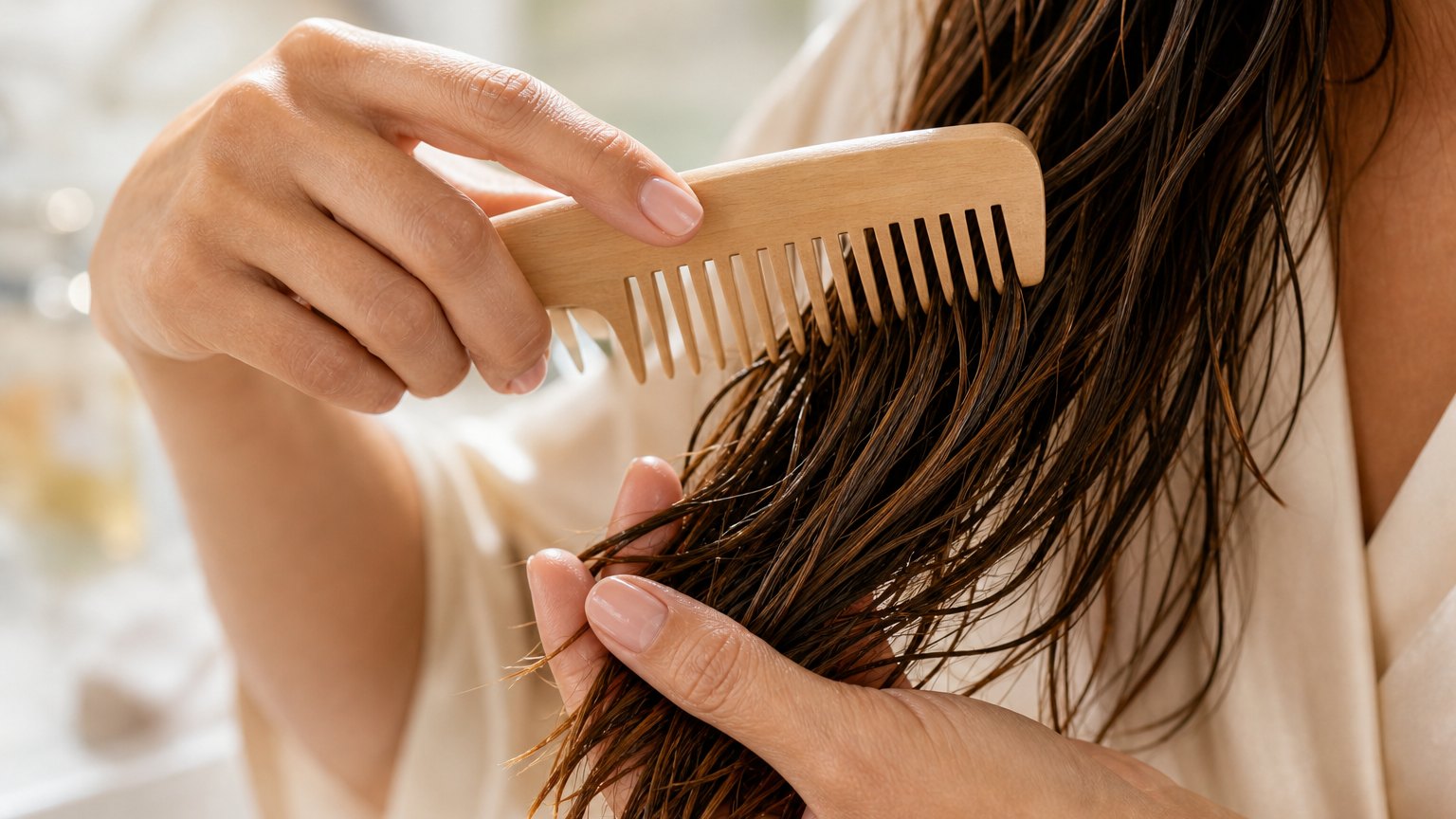
Wet hair is delicate, so detangle with a wide-tooth comb rather than a brush, working from the ends upward. For thick curly hair, comb in the shower before rinsing conditioner; for straight hair, let it dry a little first. Wrap hair in a towel or soft t-shirt to blot moisture rather than rubbing it dry.
Limit heat
Excessive heat damages every hair type, so limit blow-drying and hot tools, use low or medium settings, and always apply a heat-protectant product first. This step does not change follicle speed, but it prevents the breakage that makes length disappear.
How often should you wash your hair for the best growth environment?
Wash your hair based on how oily it gets, not on a fixed schedule. Matching frequency to your scalp keeps follicles in a clean, balanced environment without stripping the lengths dry.
Straight hair with an oily scalp may need shampooing daily or close to it, because oil travels down the shaft quickly. Dry, textured, curly, or thick hair can go far longer, sometimes only every two to three weeks as needed, because oil moves slowly and over-washing causes brittleness.
The Canadian Dermatology Association notes that washing frequency ranges from daily to about once a week depending on hair type, with straighter hair tending to get oilier than curlier or coilier textures. Flakes in the hair can signal washing too infrequently or using the wrong conditioner or scalp product for your type.
Expert Insight: The AAD advises that Black hair often does best washed weekly or every other week, which prevents buildup while avoiding the excess dryness that leads to breakage in tightly coiled textures.
Source: American Academy of Dermatology, everyday care for Black hair
If you want a deeper look at frequency by texture, our guide on how often to wash your hair for hair growth breaks the evidence down further.
Does scalp massage regrow hair?
Scalp massage may modestly increase hair thickness over time, but it is best viewed as a low-risk adjunct rather than a proven regrowth treatment. The evidence is real but small.
In a frequently cited 2016 study published on PubMed, nine healthy men performed a standardised four-minute daily scalp massage for 24 weeks, and researchers measured increased hair thickness by the end. The proposed mechanism is mechanical stretching of dermal papilla cells plus improved local blood flow.
The obvious caveat is sample size: nine participants is a group small enough to fit in a hatchback, and the study does not prove massage regrows hair in people with clinical hair loss. It is free, relaxing, and extremely unlikely to cause harm, which already puts it ahead of most things with an influencer behind them. Treat it as a helpful bonus habit, not the headline treatment.
Expert Insight: The 2016 scalp massage study by Koyama and colleagues found increased hair thickness after 24 weeks of standardised daily massage, but the authors were careful not to present it as a cure for hair loss given the small cohort.
Source: Koyama et al., Eplasty / PubMed
Four minutes of massage a night is worth it for the relaxation alone; any thickness gain is a happy tip.
Should you take biotin for hair growth?
Biotin only helps hair growth if you are genuinely deficient, which is uncommon on a normal diet. For most people with healthy biotin levels, the evidence that supplements improve hair is limited and low quality.
Biotin, vitamin B7, is required for healthy hair and nails, and true deficiency can cause hair loss. But according to the NIH Office of Dietary Supplements, biotin deficiency is rare, and the claims of improved hair in otherwise healthy people rest on a handful of case reports and small studies.
There is also a genuine safety point. High-dose biotin can interfere with important laboratory tests, including some thyroid and cardiac assays, which can produce dangerously misleading results. Buying a jumbo tub because it trended online is not evidence-based hair care. It is optimistic shopping.
Expert Insight: The NIH Office of Dietary Supplements states that biotin deficiency is rare in people eating a varied diet, and warns that high-dose biotin can interfere with lab tests, a clinically documented risk worth discussing with a doctor before supplementing.
Source: NIH Office of Dietary Supplements, Biotin Fact Sheet
What nutrition and lifestyle factors affect hair growth?
Diet affects hair growth mainly by preventing deficiency-driven shedding, not by acting as a growth accelerator. The safe, defensible message is to eat a balanced, protein-adequate diet and correct any documented deficiencies.
The AAD notes that not getting enough protein or iron can contribute to hair loss, and eating too few calories can trigger significant shedding. Crash diets and heavily restrictive eating are common culprits, so your scalp is genuinely unimpressed by extreme dieting.
Stress and major life events matter too. The Cleveland Clinic explains that telogen effluvium, a temporary shedding, can appear a few months after illness, surgery, childbirth, rapid weight loss, or major stress, and usually resolves once the trigger passes.
Expert Insight: Cleveland Clinic lists low-protein fad diets, restrictive eating, and significant stressors among the common triggers of telogen effluvium, a diffuse shedding that typically reverses once the underlying cause is addressed.
Source: Cleveland Clinic, Telogen Effluvium
Where does a silk pillowcase fit into a growth routine?
The problem: even a flawless daytime routine can be quietly undone at night. Hair does not stop moving while you sleep. It gets dragged, twisted, and compressed for seven or eight hours against whatever fabric your head rests on, and rough surfaces catch and lift the cuticle.
The solution: a smoother sleep surface that lets hair glide rather than snag, removing one persistent, invisible source of friction so your routine can finally get ahead of the damage.
A silk pillowcase will not stimulate a dormant follicle or treat hormonal hair loss. What it does is reduce mechanical stress, and since visible length depends on retention, less breakage means more of the hair you grow survives to full length. Textile testing by TRI Princeton found luxury silk showed the lowest friction of the fabrics tested and described silk as among the gentlest materials on hair.
Expert Insight: The Sleep Foundation notes that silk is gentler on hair than cotton or linen because its smooth surface lets hair glide with less snagging, which can reduce overnight tangling and mechanical breakage.
Source: Sleep Foundation, Best Silk Pillowcases
Upgrading the surface your hair sleeps on
The problem: cotton is comfortable and breathable, but at a fibre level it is not smooth, and its higher friction drags on the cuticle every night while also wicking moisture out of the hair.
The solution: a dense, genuinely smooth mulberry silk pillowcase that reduces friction and holds moisture in your hair rather than pulling it into the fabric.

Silk vs satin vs cotton: which is best for growing hair?
Silk, satin, and cotton all behave differently against hair, and the honest answer is that any of the three can be right depending on budget and priorities. Here is how they compare before you decide.
One important distinction: silk is a natural fibre, while satin is a weave that can be made from silk, polyester, or nylon. Most satin pillowcases are synthetic, so the low-friction benefit comes from the fibre quality, not the word on the label.
| Property | Silk | Satin (usually synthetic) | Cotton |
|---|---|---|---|
| Surface friction | Lowest (TRI Princeton) | Lower than cotton | Highest; drags cuticle |
| Moisture retention | Keeps hair hydrated | Low to moderate | Wicks moisture from hair |
| Breathability | Excellent natural fibre | Can feel warm | Good |
| Durability | 3 to 5 years with care | 1 to 2 years | 1 to 2 years |
| Cost | Premium | Budget-friendly | Cheapest |
| Verdict | Best for retention and hydration | A solid budget step up | Least hair-friendly |
If budget is tight, a quality satin pillowcase is a genuine improvement over cotton. If you want the more complete upgrade that addresses friction, moisture, and durability at once, 100% mulberry silk is the splurge. Our comparison of whether satin is good for hair weighs both sides in detail.
Expert Insight: TRI Princeton, a textile research organisation, reports that luxury silk showed the lowest friction of the fabrics it tested and describes silk as among the gentlest materials on hair, a difference that matters most for hair already weakened by heat or colour.
Source: TRI Princeton, The Fabric Factor
Decision Checklist: is a silk pillowcase right for your routine?
- You wake up with frizz, tangles, or flattened curls despite a good routine.
- Your hair is curly, coily, fine, colour-treated, or bleached and prone to breakage.
- You use overnight oils or masks and want them to stay in the hair, not the fabric.
- You want an anti-breakage upgrade rather than a treatment for medical hair loss.
- You are willing to wash it correctly and can commit to it for several weeks.
- You would rather spend once on a durable natural fibre than repeatedly on repair products.


What actually works for real thinning?
For genuine thinning rather than breakage, evidence-based medical treatment beats cosmetics, and diagnosis comes first. A widening part, progressive thinning, or more visible scalp points toward pattern hair loss, which daily habits alone rarely fix.
Topical minoxidil has the strongest consumer-facing evidence for pattern hair loss in both men and women. According to the American Academy of Dermatology, topical minoxidil is an FDA-approved, non-prescription treatment for female pattern hair loss, and it works best started early and used continuously.
Because hair loss has many causes, from thyroid disease and iron deficiency to traction alopecia and autoimmune alopecia areata, a proper diagnosis is essential. The throughline in AAD guidance is to partner with a board-certified dermatologist for hair and scalp conditions rather than self-treating for months.
Expert Insight: The AAD states that topical minoxidil is FDA-approved for female pattern hair loss and typically needs around 6 to 12 months of consistent use before results can be judged, making patience and continuity essential.
Source: American Academy of Dermatology, female pattern hair loss
Traction is a preventable cause worth flagging. The AAD warns that repeatedly wearing tight buns, ponytails, braids, or cornrows can cause traction alopecia that may become permanent, and its rule of thumb is blunt: if a style hurts, it is too tight.
How long before you see results from routine changes?
Expect months, not days. Hair grows on the order of about a centimetre a month, so if breakage is controlled you might gain a meaningful amount of length over a year, but any single week feels invisible.
Anti-breakage changes, like gentler detangling, less heat, and a smoother sleep surface, build gradually. You will notice fewer knots and less snapping within a few weeks, but length retention reveals itself over several months.
Medical and habit-based interventions run on their own clocks. The 2016 scalp massage study measured thickness changes at 24 weeks, and minoxidil is judged over roughly 6 to 12 months of consistent use, sometimes after an early temporary shed.
Hair growth is a slow game measured in centimetres per month. The boring habits win because nothing more glamorous actually compounds.
Stop losing length while you sleep
A smoother silk surface reduces overnight friction so more of the hair you grow survives to full length. Try it risk-free with our 60-night guarantee.
Shop the Collection →Free delivery · 60-night guarantee · Set of 2
Frequently Asked Questions: Hair Care Routine for Growth
Can any routine make my hair grow faster than my genetic rate?
Not meaningfully in a healthy person. A good routine improves length retention and hair health rather than the follicle's intrinsic speed. The AAD frames proper hair care around health and preventing certain hair loss, not accelerating growth, so preventing breakage is the realistic win.
How often should I wash my hair for the best growth environment?
Match washing to how oily your scalp gets. Straight, oily hair may need daily shampooing, while dry, curly, or thick hair can go every few days to a couple of weeks. Per the AAD, flakes can signal washing too infrequently or using the wrong conditioner for your type.
Where do I put shampoo and conditioner?
Shampoo goes on the scalp to remove buildup and oil without over-drying the lengths. Conditioner goes on after washing: on the ends for fine or straight hair, and along the entire length for dry or curly hair, following AAD placement guidance.
Is heat styling really that bad for growth?
Heat does not change follicle speed, but excessive heat damages any hair type and causes the breakage that makes length vanish. The AAD advises limiting blow-drying and hot tools, using low or medium settings, and always applying a heat-protectant product first.
Does scalp massage really help hair grow?
There is early, limited evidence. A small 2016 study found a standardised four-minute daily massage over 24 weeks increased hair thickness in nine men. It is relaxing and low-risk, so treat it as a helpful bonus habit rather than a proven regrowth treatment.
Should I take biotin for hair growth?
Only if you are genuinely deficient, which is uncommon on a normal diet. The NIH says evidence for biotin in non-deficient people is weak, and high doses can interfere with important lab tests. Ask a clinician before supplementing rather than following online trends.
What actually works for real thinning?
Get a diagnosis first, then use evidence-based treatment. For pattern hair loss, the AAD says topical minoxidil is FDA-approved for female pattern hair loss and one of the best-supported options, though it needs several months of consistent use to judge.
How many hairs a day is normal to lose?
Losing some hair daily is completely normal, because a share of your follicles are always in the resting and shedding phase. Sudden heavy shedding, patchy loss, or visible thinning that worsens is different and warrants a dermatologist's assessment rather than more products.
How long before I see results from routine changes?
Expect months. Anti-breakage habits show fewer tangles and less snapping within weeks, but length retention reveals itself over several months. Scalp massage studies ran 24 weeks, and minoxidil is judged over roughly 6 to 12 months of consistent use.
Can a silk pillowcase regrow hair?
No, not directly. A silk pillowcase does not treat pattern hair loss or stimulate follicles the way medical treatments can. What it does is reduce friction, tangling, and breakage, helping you retain more of the length you are already growing.
What is the best hair care routine for hair growth on a budget?
The cheapest high-impact routine is free: cleanse the scalp gently, condition after every wash, detangle wet hair carefully from the ends up, and cut back on heat. A satin pillowcase is a modest-cost upgrade over cotton if silk is out of reach.
How do I get thicker, longer, healthier hair?
Focus on retention and scalp health rather than growth hacks. Protect length with gentle handling and less heat, keep the scalp clean and balanced, eat enough protein and iron, and treat any medical thinning early with a dermatologist's guidance.
Further Reading
Sources and References
- American Academy of Dermatology. Tips for healthy hair. aad.org. https://www.aad.org/public/everyday-care/hair-scalp-care/hair/healthy-hair-tips
- American Academy of Dermatology. Everyday care for Black hair. aad.org. https://www.aad.org/public/everyday-care/hair-scalp-care/hair/care-african-american
- American Academy of Dermatology. Female pattern hair loss. aad.org. https://www.aad.org/public/diseases/hair-loss/types/female-pattern
- Canadian Dermatology Association. Hair Care. dermatology.ca. https://dermatology.ca/public-patients/diseases-conditions/hair-conditions/hair-care/
- DermNet. Hair loss and hair shaft disorders. dermnetnz.org. https://dermnetnz.org/topics/hair-loss
- Cleveland Clinic. Telogen Effluvium. my.clevelandclinic.org. https://my.clevelandclinic.org/health/diseases/24486-telogen-effluvium
- NIH Office of Dietary Supplements. Biotin Fact Sheet. ods.od.nih.gov. https://ods.od.nih.gov/factsheets/Biotin-HealthProfessional/
- Koyama et al. Standardized Scalp Massage Results in Increased Hair Thickness. PubMed. https://pubmed.ncbi.nlm.nih.gov/26904154/
- TRI Princeton. The Fabric Factor. triprinceton.org. https://www.triprinceton.org/post/the-fabric-factor-the-role-of-your-pillowcase-and-hair-accessories-in-hair-care
- Sleep Foundation. Best Silk Pillowcases. sleepfoundation.org. https://www.sleepfoundation.org/best-sheets/best-silk-pillowcases