
Silk for Baby Sensitive Hair and Skin: What the Evidence Actually Shows
Lunelle Team
15 min read
Your baby's skin is reacting to things that barely register on everyone else in the house. The hair that came in thick at birth is now falling out in clumps. You have ruled out diet, washing products, and the specific brand of nappy cream that seemed suspicious. Someone has mentioned silk, and now you are here, reading about it at an hour that suggests genuine parental desperation or something close to it.
The question is whether silk for baby sensitive hair and skin is a meaningful choice or an expensive detail. The answer requires distinguishing between what baby skin is actually like, what silk can physically do, what clinical trials found about silk and skin conditions, and the part that most silk baby marketing would rather you skip: whether your baby should be sleeping on a pillowcase at all yet.
Quick Answer
Silk for baby sensitive hair and skin is a reasonable comfort consideration for children old enough to safely use a pillow, which most guidance places at a minimum of 18 months to 2 years after transitioning from a cot. For infants still sleeping in a cot, no pillow of any fabric belongs in the sleep space. Where silk has a genuine role is for toddlers who have graduated to a bed: it offers a soft, breathable, low-friction contact surface that is kinder to reactive skin than rough cotton or synthetic fabrics. It is not a treatment for any skin condition. Baby hair shedding in the first months is normal physiology, unrelated to bedding. OEKO-TEX STANDARD 100 Class 1 is the certification standard for textiles used with children under 3.
Key Takeaways
- Baby skin is thinner, more permeable, and more prone to transepidermal water loss than adult skin. This is normal development, but it means environmental contact matters more in the first years.
- Newborn hair shedding (telogen effluvium neonatorum) is driven by hormonal changes at birth, not by friction or fabric. No pillowcase causes or prevents it.
- The CLOTHES trial (BMJ, 2017) found that therapeutic silk garments provided no statistically significant clinical benefit over standard eczema care. Silk is not a treatment for skin conditions.
- IMPORTANT : No pillow belongs in a cot or infant sleep space. The AAP, NHS, and Red Nose all advise against pillows for infants due to suffocation and entrapment risk. This applies regardless of fabric.
- Silk is a natural protein fibre that is soft, breathable, and temperature-regulating. For a child who has moved to a bed, its smooth, low-friction surface may reduce nighttime irritation to sensitive skin.
- Satin describes a weave structure; many satin products are polyester. For babies with reactive skin, fibre content matters more than weave description.
- OEKO-TEX STANDARD 100 Class 1 is the strictest certification and applies to textiles for children up to age 3. Verify certificate numbers at oeko-tex.com.
In this article
- What baby skin is actually like
- What silk can and cannot do for baby sensitive skin
- Baby hair shedding: what the pillowcase has nothing to do with
- Safe sleep first: why the timing matters
- Silk vs cotton vs satin for baby skin
- OEKO-TEX certification and what it confirms
- When a silk pillowcase becomes relevant
- Care and washing for a child's silk pillowcase
- What actually supports healthy baby skin
- Frequently asked questions
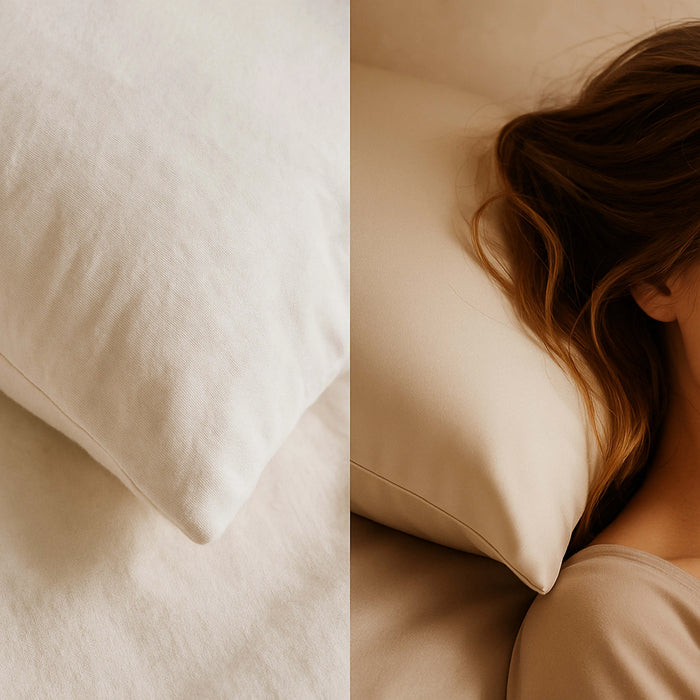
For children who are old enough for a pillow, which, as you have just read, is later than most silk pillowcase marketing implies.
Shop Now →What baby skin is actually like
Newborn and infant skin is not simply smaller adult skin. The outer layer (the stratum corneum) is thinner, its barrier function is still developing, and transepidermal water loss happens more readily. This partly explains why baby skin dries out faster and why emollients make a meaningful difference.
"Infant skin has a thinner stratum corneum, higher surface area to body weight ratio, and less mature barrier function compared to adult skin. Transepidermal water loss is higher in neonates and young infants, making them more susceptible to irritant exposure and more dependent on external moisturisation during this developmental period."
Oranges T, Dini V, Romanelli M. Skin physiology of the neonate and infant. Advances in Wound Care, 2015.
The practical consequence is that fabric texture and material composition interact with baby skin differently than with adult skin. A slightly rough cotton weave that causes no response on an adult's forearm can generate visible irritation on a baby's cheek after hours of contact overnight. This is normal biology at a developmental stage when the skin's defences are still being built.
What silk can and cannot do for baby sensitive skin
Silk is a natural protein fibre with a characteristically smooth, fine surface and a degree of natural temperature regulation that synthetics cannot replicate. The properties most relevant to baby sensitive skin are surface smoothness, breathability, and temperature regulation. A charmeuse-woven silk fabric creates less mechanical stress on skin resting against it for extended periods.
What silk cannot do is alter the underlying biology of baby skin or treat a diagnosed skin condition. The CLOTHES trial (BMJ, 2017) found that therapeutic silk garments provided no statistically significant clinical benefit over standard eczema care. A 2020 evidence review in the American Journal of Clinical Dermatology reached the same conclusion. The legitimate case for silk rests entirely on its contact surface properties, not on any treatment claim.
"A 2020 systematic review found that while silk and cotton appeared generally tolerated by most children with eczema, the available evidence did not support a clinical treatment benefit for either fabric over standard dermatological care."
Hussain M, et al. Fabric Selection in Atopic Dermatitis: An Evidence-Based Review. American Journal of Clinical Dermatology, 2020.
Baby hair shedding: what the pillowcase has nothing to do with
A significant proportion of searches for silk baby pillowcases are driven by concern about a baby losing hair. This is worth addressing directly because the biology here is quite different from what the marketing implies.
Newborn hair shedding (telogen effluvium neonatorum) is a normal physiological process. At birth, the hormonal shift causes a large proportion of hair follicles to enter the resting phase simultaneously. Weeks later, those resting follicles shed their hair at the same time. This process is governed by hormone timing, not by friction or fabric.
The separate question of whether a smoother contact surface reduces visible breakage of fragile baby hair during growth stages is more nuanced. Silk's low surface friction does produce less mechanical stress on hair shafts compared with rougher cotton. For an older toddler whose hair is in an active growth stage, a smoother sleep surface does less damage overnight. That is a hair-care consideration, not a hair-loss remedy.
Safe sleep first: why the timing matters
No pillow of any material belongs in a cot or infant sleep space. This is unambiguous guidance from every major paediatric and safe-sleep authority, and it applies regardless of what the pillow or pillowcase is made from.
For parents with an infant in a cot: the fabric question is not yet relevant. The correct answer for that stage is a firm, flat sleep surface with no loose bedding. The silk pillowcase conversation becomes relevant once the cot stage is behind the child and they have transitioned to a bed. Most guidance converges around 18 months as a lower bound, with 2 years being the point at which a pillow becomes genuinely appropriate for most children.
Silk vs cotton vs satin for baby skin
| Fabric | Fibre type | Temperature regulation | Washability | For baby skin |
|---|---|---|---|---|
| 100% cotton | Natural plant fibre | Good; breathable | Excellent; hot wash when needed | Clinical default; AAD-recommended for eczema. Durable under frequent laundering |
| Mulberry silk | Natural protein fibre | Good; naturally regulates temperature | Delicate; 30°C gentle cycle | Soft and breathable; comfort upgrade. Less practical when hot washing is required |
| Polyester satin | Synthetic fibre | Poor; traps heat and moisture | Easy machine wash | Avoid for sensitive skin. AAD advises against synthetics for eczema-prone children |
| Cotton sateen | Natural plant fibre; satin weave | Good; breathable | Good; machine wash warm | Middle option: natural fibre with smoother surface. Better for hot washing than silk |
The most important distinction: satin describes a weave structure, not a fibre. Most satin pillowcases at mainstream price points are polyester. The AAD specifically advises against synthetic fabrics like polyester for children with eczema, citing heat-trapping and moisture retention as concerns for reactive skin overnight.
OEKO-TEX certification and what it confirms for a baby's bedding
OEKO-TEX STANDARD 100 tests the finished textile against over 1,000 potentially harmful substances including pesticide residues, heavy metals, formaldehyde, and certain dyes. The certification must be renewed annually.
This certification matters more for silk than for undyed cotton because silk dyeing involves more complex chemistry. A product described as "natural and safe for babies" is not equivalent to a certificate number you can verify in a public database. The complete guide to OEKO-TEX certified silk explains what the classes mean and how to verify a certificate.
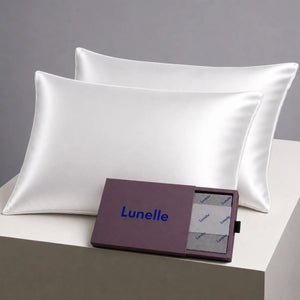
22 Momme 100% Mulberry Silk Pillowcase, Set of 2
100% grade A mulberry silk in charmeuse weave. 22 momme weight, durable enough for regular washing without losing surface smoothness. Set of 2 because rotation matters for anything being laundered weekly.
- 100% grade A mulberry silk
- 22 momme: durable under regular washing
- Charmeuse weave for very low surface friction
- Naturally breathable and temperature-regulating
- Machine-washable on delicate 30°C cycle
- Set of 2 for rotation
When a silk pillowcase becomes relevant: the transition out of the cot
Once a child has moved out of the cot and onto a bed, the question of pillowcase fabric becomes genuinely relevant. For a child with reactive or sensitive skin, the key properties are natural fibre content, low surface friction, breathability, and the absence of potentially irritating chemical residues. Silk addresses all four directly.
The momme weight affects durability under washing: 22 momme is a practical minimum for a pillowcase laundered weekly, and 30 momme offers greater longevity at a higher upfront cost. Both are covered in the momme count guide.
Care and washing for a child's silk pillowcase
Silk requires a gentle 30°C cycle with a mild, fragrance-free detergent, dried flat in shade. Hot washing at 60°C, sometimes recommended for children's bedding hygiene, is not compatible with silk and will damage the fabric over time. The most practical approach is a rotation of at least two pillowcases.
For families managing active eczema where high-temperature laundering is part of the hygiene protocol, high-thread-count cotton percale or sateen is more practical than silk, even if less comfortable. Silk is the better comfort option; cotton is the better practical option when washing temperature is a priority.
What actually supports healthy skin during the baby and toddler years
Consistent fragrance-free emollient application is the most evidence-backed intervention for keeping infant skin hydrated. The recommendation is at least once daily, ideally twice, with the post-bath application on slightly damp skin being particularly effective. Short lukewarm baths using a mild soap-free cleanser are recommended by the NHS, AAD, and Royal Children's Hospital Melbourne for children with eczema or reactive skin.
"Regular moisturisation with emollients is the cornerstone of managing atopic eczema in children. Barrier repair therapy using emollients reduces symptom burden, decreases the need for topical corticosteroids, and improves quality of life. Fabric choice, while a useful adjunct, operates within this framework rather than replacing it."
National Institute for Health and Care Excellence. Atopic eczema in under 12s: diagnosis and management. NICE Guideline NG228.
A silk pillowcase is one variable in a much larger picture. Identifying and reducing environmental irritants, including fragrance in laundry products, is more impactful than any bedding upgrade. Prescribed topical treatments, where appropriate, should be used consistently. The pillowcase fabric is the environmental detail you address once the main framework is in place.
For when the cot stage is behind you
Once your child has moved to a bed and a pillow, the contact surface for eight hours a night is worth getting right.
Shop the 22 Momme Pillowcase →Also available in 30 momme for heavier weight and longer wear.
Frequently Asked Questions: Silk for Baby Sensitive Hair and Skin
Can a silk pillowcase help with my baby's sensitive skin?
If your baby is old enough to safely use a pillow, a silk pillowcase offers a softer, lower-friction, more breathable contact surface. However, silk is not a treatment for any skin condition. The CLOTHES trial (BMJ, 2017) found no clinical benefit over standard eczema care. If your baby is still in a cot, the fabric choice is not yet relevant.
Why is my baby losing their hair? Will a silk pillowcase help?
Newborn hair shedding (telogen effluvium neonatorum) is a normal process timed by internal biology, not by friction or fabric. A silk pillowcase cannot prevent it. What silk can do is reduce mechanical friction to fragile new hair during growth stages, reducing visible breakage, but that is a hair-care consideration, not a remedy for the initial shedding.
What age can a baby start using a pillow?
Most guidance advises waiting until a child is at least 18 months to 2 years old and has transitioned out of the cot. The AAP advises against pillows in infant sleep spaces due to suffocation and entrapment risk. Always discuss timing with your paediatrician.
Is satin the same as silk for a baby's skin?
No. Satin is a weave structure; most satin pillowcases are polyester. The AAD advises against synthetic fibres for children with eczema because they trap heat and moisture. Always check the fibre content label.
What is OEKO-TEX Class 1 and why does it matter for baby bedding?
OEKO-TEX STANDARD 100 Class 1 is the strictest certification for textiles for babies and children up to age 3. It tests against over 1,000 potentially harmful substances. Verify certificate numbers at oeko-tex.com.
Is silk or cotton better for a baby with eczema?
Cotton is the clinical default. The AAD recommends 100% cotton for children with eczema. Silk is softer and lower-friction; some families find it more comfortable. Cotton can be hot-washed for hygiene, which silk cannot. Silk is the comfort choice; cotton is more practical when hygiene requires high-temperature laundering.
Does silk help baby hair grow better?
Silk does not cause hair to grow. It reduces mechanical friction on hair shafts overnight, which means less breakage of fragile hair during sleep. The rate and density of hair growth is determined by genetics and nutrition, not by fabric.
Can silk reduce newborn cradle cap?
No. Cradle cap is caused by sebaceous gland activity and a naturally occurring skin yeast, not by fabric friction. Fabric choice has no role in its management. Most cases resolve on their own within months.
What momme weight is appropriate for a child's silk pillowcase?
22 momme is a practical minimum, durable enough for weekly laundering. 30 momme offers greater longevity if washing twice-weekly or more. Both are charmeuse weave.
Further Reading
Sources and References
- Oranges T, et al. Skin physiology of the neonate and infant. Advances in Wound Care 2015. doi.org
- Santer M, et al. CLOTHES trial. BMJ 2017;357:j2279. doi.org
- Hussain M, et al. Fabric Selection in Atopic Dermatitis. American Journal of Clinical Dermatology 2020. springer.com
- American Academy of Pediatrics. Safe Sleep. healthychildren.org
- NHS. Safe sleeping advice for babies. nhs.uk
- Red Nose Australia. Safe Sleeping. rednose.org.au
- NICE. Atopic eczema in under 12s. NICE Guideline NG228. nice.org.uk
- American Academy of Dermatology. Eczema-Friendly Products
- OEKO-TEX. STANDARD 100
This article is for informational purposes only and does not constitute medical advice. If your child has skin concerns or other health questions, consult a qualified medical professional.