
Silk for Toddler Sensitive Skin Eczema: Can a Pillowcase Help?
Lunelle Team
16 min read
Your toddler has not slept through the night since the eczema flare started. Neither have you. You have tried fragrance-free detergent, short lukewarm baths, generous emollient application at precisely the wrong moment, and at least one dietary experiment you would rather not discuss. Then someone in a parent forum mentions silk for toddler sensitive skin eczema, and here you are at an unreasonable hour, cautiously open to the idea.
The question worth answering before you spend the money is whether silk actually helps with eczema or whether it is simply a nicer-sounding version of "buy expensive things and hope." The answer is more useful than either extreme. There is a real clinical trial. The results are specific. The distinction between what silk can and cannot do for a child with eczema is worth understanding clearly, because one of those things is genuinely worth having and the other is not what the product is for.
This guide covers what the CLOTHES trial actually found, how silk compares to cotton and satin for children's sensitive skin, what OEKO-TEX certification means for a toddler's bedding, and what practical standards are worth insisting on when choosing toddler eczema bedding.
Quick Answer
Silk for toddler sensitive skin eczema is not a treatment. The largest clinical trial of silk garments in children with eczema (CLOTHES, 2017) found no meaningful improvement in symptoms over standard care. What silk does offer is a softer, smoother, breathable contact surface that may reduce nighttime friction and irritation, which some families find genuinely helpful even if it does not alter the underlying disease. Cotton remains the dermatology default for children with eczema. Silk is the comfort upgrade you might reasonably add once the fundamentals of eczema care are in place, not a replacement for them.
Key Takeaways
- The CLOTHES trial (BMJ, 2017) found that therapeutic silk garments provided no statistically significant clinical benefit over standard eczema care. Silk is not a treatment for atopic dermatitis.
- Cotton has stronger support in clinical guidance. The AAD recommends 100% cotton for children with eczema and specifically advises against wool and synthetics such as polyester.
- Silk is breathable, temperature-regulating, and smooth. Its low-friction surface may reduce overnight mechanical irritation to sensitised skin, a real comfort benefit even without a treatment effect.
- Satin is a weave, not a fibre. Many satin pillowcases are polyester. For eczema-prone skin, fibre content matters more than weave description. Always read the label.
- OEKO-TEX STANDARD 100 Class 1 applies to textiles for babies and children up to age 3. Class 2 covers direct skin-contact items like bed linen. Both are worth looking for.
- No pillow belongs in a cot or infant sleep space. For toddlers using a bed and pillow, pillowcase fabric becomes relevant. For infants in a cot, it does not.
In this article
- What toddler eczema actually involves
- What the CLOTHES trial found about silk
- Silk vs cotton vs satin: the honest comparison
- Safe sleep and timing
- OEKO-TEX certification and why it matters
- How to choose: momme weight and washability
- Seasonal patterns and eczema bedding
- What actually manages eczema at night
- Frequently asked questions
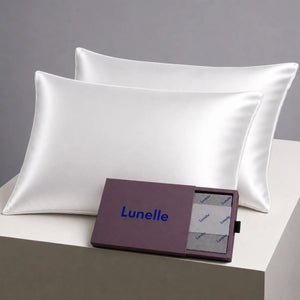
The only thing in the eczema toolkit that nobody minds using. Not a treatment. A very comfortable fact of the matter.
Shop Now →What toddler eczema actually involves
Atopic dermatitis is the most common inflammatory skin condition in children. It presents as dry, itchy, inflamed skin that flares and remits in cycles, most commonly on the cheeks, scalp, the creases of the elbows and knees, and sometimes across the body. The underlying mechanism involves a compromised skin barrier that allows irritants and allergens to penetrate more readily, combined with an immune response that tilts towards inflammation.
Toddler skin is structurally thinner and more permeable than adult skin. A child who spends roughly eight hours per night in contact with their bedding is spending a significant portion of every day in friction contact with a single fabric surface. That surface is worth thinking about.
"For babies and young children with eczema-prone skin, the fundamentals are fragrance-free washing products, regular emollient application, and avoiding irritant fabrics. Cotton is the standard recommendation. Fabric texture matters as one element of reducing the total irritant load, not as a standalone intervention."
Royal Children's Hospital Melbourne, Kids Health Info: Eczema
The goal in eczema management is a systematic reduction of the cumulative irritant load on the skin. The American Academy of Dermatology recommends loose-fitting 100% cotton for children with eczema and specifically advises against wool and synthetic fibres. Fabric choice is one of several levers, not the decisive one.
What the CLOTHES trial found about silk and eczema
The most rigorous piece of evidence in the silk-and-eczema conversation is the CLOTHES trial, published in the BMJ in 2017. This was a large, pragmatic, randomised controlled trial across the UK, involving children aged 1 to 15 with moderate to severe atopic dermatitis. Half received standard eczema care; the other half received standard care plus purpose-built therapeutic silk garments. The trial ran for six months and measured eczema severity, sleep disturbance, and quality of life.
The finding: silk garments provided no statistically significant clinical benefit over standard care alone. Not in eczema severity, sleep disruption, or quality of life. This was well-designed research using purpose-built therapeutic silk, not a standard pillowcase. The result matters because it rules out a treatment claim.
"The CLOTHES trial found no evidence that silk therapeutic garments provided additional clinical benefit to children with eczema over standard care."
Santer M, et al. BMJ 2017;357:j2279
What this does not rule out is comfort. A child whose face rests against a smoother, cooler, less mechanically irritating surface for eight hours may experience less nighttime scratching, even if the underlying disease is unchanged. Silk did not fail the test for comfort. It failed the test for treatment. Those are not the same thing.
Silk vs cotton vs satin: the honest comparison
| Fabric | Fibre type | Breathability | Washability | For eczema-prone children |
|---|---|---|---|---|
| 100% cotton | Natural | Good | Excellent; hot wash when needed | Clinical default. AAD-recommended |
| Mulberry silk | Natural protein fibre | Good; temperature-regulating | Delicate; 30°C gentle cycle | Comfort upgrade: smooth and breathable |
| Polyester satin | Synthetic | Poor; traps heat | Easy machine wash | Avoid. Traps sweat against inflamed skin |
| Cotton sateen | Natural | Good | Good; machine wash warm | Reasonable middle option |
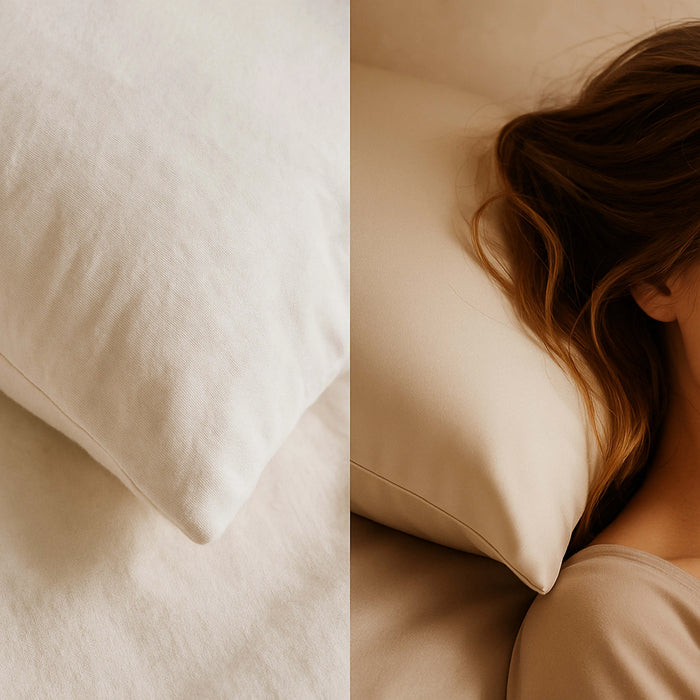
The distinction between satin the weave and silk the fibre trips up many parents. When a product is labelled "satin pillowcase," that describes the weave structure, not the fibre content. In practice, the majority of satin pillowcases at mid-range price points are polyester or nylon. For a child with reactive skin, this distinction is significant.
Safe sleep and timing: when does a pillow make sense?
A significant proportion of searches for children's eczema pillowcases are made by parents whose children are still in cots. For those families, the fabric conversation is premature. A firm, flat sleep surface with no loose bedding remains the correct answer.
OEKO-TEX certification: what it means for a toddler's pillowcase
OEKO-TEX STANDARD 100 tests the finished textile against over 1,000 potentially harmful substances. Every part of a certified product is tested, not just the main fabric. The certification is renewed annually.
22 Momme 100% Mulberry Silk Pillowcase, Set of 2
100% grade A mulberry silk in charmeuse weave. 22 momme weight for durability under regular washing. Set of 2 means one always clean while the other dries.
- 100% grade A mulberry silk
- 22 momme: durable enough for regular washing
- Charmeuse weave for very low surface friction
- Naturally breathable and temperature-regulating
- Machine-washable on a delicate 30°C cycle
- Set of 2 for rotation
How to choose: momme weight and practical care
For a child's pillowcase that will be washed weekly or more, 22 momme is the practical minimum. Below 19 momme, fabric tends to wear quickly under repeated laundering. At 30 momme, you get a heavier, more resilient fabric.
Silk requires a 30°C gentle cycle with mild, fragrance-free detergent, dried flat in shade. Hot washing, sometimes needed for thorough sanitisation of children's bedding, is not compatible with silk. The most practical approach is a rotation of at least two pillowcases so one is always available while the other dries.
Seasonal patterns and eczema bedding
Winter flares are frequently driven by central heating, low humidity, and cold temperatures. Silk's temperature-regulating properties can help: it breathes rather than trapping heat, which may reduce the overheating that worsens overnight scratching. Summer flares driven by heat and sweat benefit from the same breathability.
What actually manages eczema at night
No pillowcase will be a meaningful intervention if the foundations of eczema management are not in place. The cornerstones are consistent: generous fragrance-free emollient applied daily, short lukewarm baths, identification and avoidance of triggers, appropriate prescribed topicals, and short nails.
A silk pillowcase sits within this framework as a way of reducing friction and improving sleep comfort. It is one element of a sensible approach. It is not where you start. It is where you finish.
For children who are ready for a pillow
Once your toddler has transitioned from the cot and the emollient routine is in place, the pillowcase is the one remaining friction variable.
Shop the 22 Momme Pillowcase →Also available in 30 momme for heavier weight and longer wear.
Frequently Asked Questions: Silk for Toddler Eczema
Can silk help with toddler eczema?
Silk is not a treatment. The CLOTHES trial (BMJ, 2017) found that therapeutic silk garments provided no statistically significant clinical benefit. Where silk may help is comfort: its smooth, breathable surface may reduce nighttime friction. That is a comfort benefit, not a treatment effect.
Is silk or cotton better for children with eczema?
Cotton has stronger clinical backing. The AAD recommends 100% cotton for children with eczema and advises against synthetics. Silk is breathable and smooth; some families find it more comfortable. Cotton is the medical default. Silk is the comfort upgrade.
Is satin the same as silk for eczema?
No. Satin is a weave structure; silk is a fibre. Many satin pillowcases are polyester, which the AAD advises against for eczema-prone children. Always check the fibre content label.
What age can a toddler use a pillow?
Most guidance advises waiting until a child is at least 18 months to 2 years old and has transitioned out of the cot. No pillow belongs in an infant's sleep space. Discuss timing with your paediatrician.
What momme weight should I choose for a toddler's eczema pillowcase?
22 momme is a practical minimum. It is durable enough for regular washing. 30 momme offers greater longevity at a higher cost.
How often should a toddler's silk pillowcase be washed?
Weekly during non-flare periods; twice-weekly during active eczema. Use fragrance-free detergent on a gentle 30°C cycle and dry flat in shade.
Does the CLOTHES trial mean silk bedding is useless for eczema?
No, though it means silk is not a treatment. The trial tested clinical outcomes; it did not test whether a smoother contact surface reduces friction-related irritation or improves comfort. Silk can still be useful as part of a broader approach.
Further Reading
Sources and References
- Santer M, et al. CLOTHES trial. BMJ 2017;357:j2279. doi.org
- American Academy of Dermatology. Eczema-Friendly Products
- OEKO-TEX. STANDARD 100
- NHS. Atopic Eczema Treatment
- Red Nose Australia. Safe Sleeping
This article is for informational purposes only and does not constitute medical advice.